⌕ Search
İstihbarat Üzerine/Intelligence Guide/How Is Risk Assessed in Intelligence?
GRAPHIC 17
Intelligence Guide — Security

How Is Risk Assessed in Intelligence?

Risk is the combination of the likelihood of a threat materialising and the impact it would have if it did. The aim of risk management is not to eliminate risk but to reduce it to an acceptable level.
Prepared by: Furkan Emir Akca — based on the book İstihbarat Üzerine
In the book: Chapter 6 — Threat and Risk Analysis
Last updated: September 2026

✓ SHORT ANSWER

Risk is the combination of the likelihood of a threat materialising and the impact it would have if it did. The aim of risk management is not to eliminate risk but to reduce it to an acceptable level.

Graphic

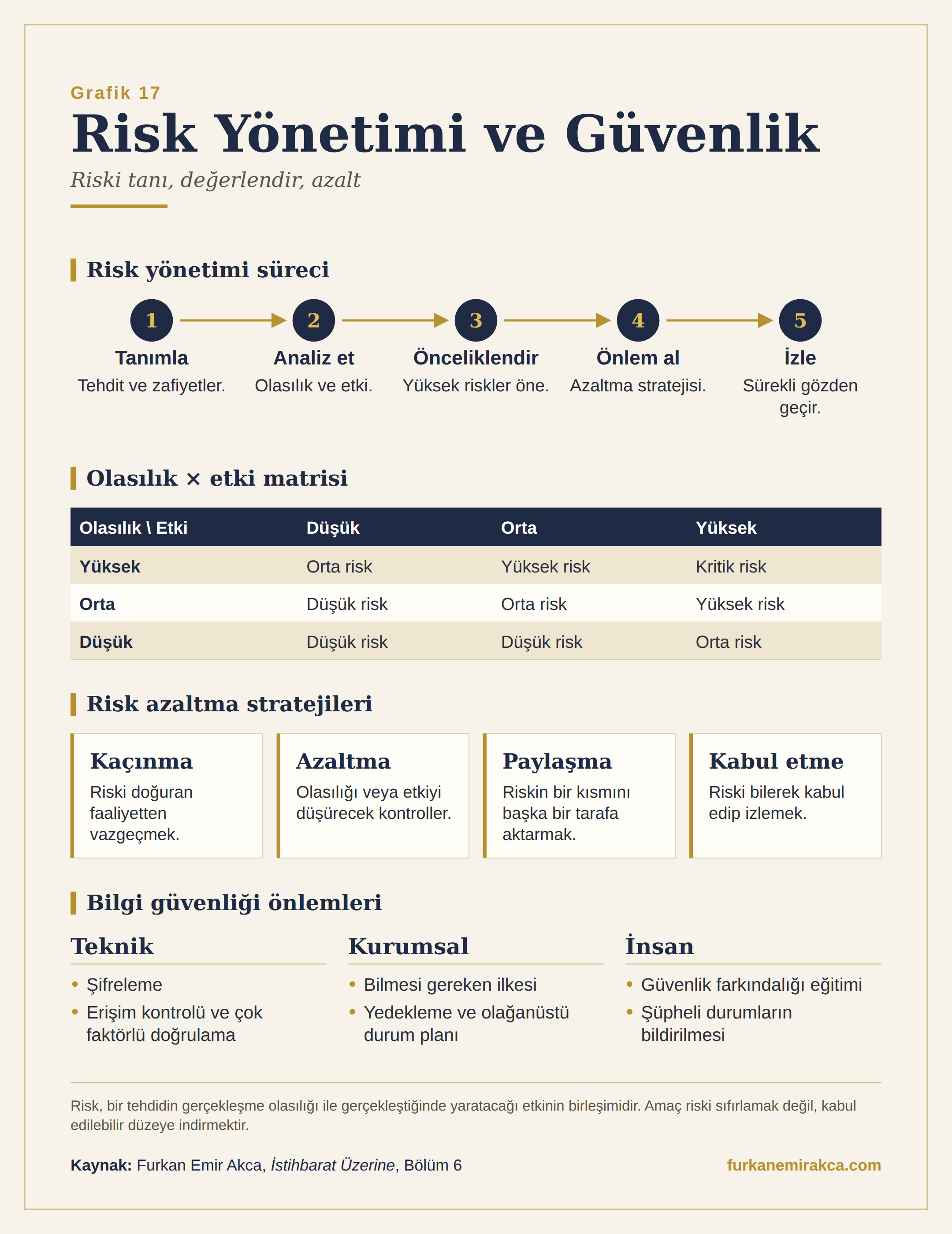
Risk Management and SecurityRisk Management and Security Identify, assess and reduce risk The risk management process 1. Identify: Threats and vulnerabilities. 2. Analyse: Likelihood and impact. 3. Prioritise: High risks first. 4. Take measures: Mitigation strategy. 5. Monitor: Review continuously. Likelihood × impact matrix High | Medium risk | High risk | Critical risk Medium | Low risk | Medium risk | High risk Low | Low risk | Low risk | Medium risk Risk mitigation strategies Avoidance: Abandoning the activity that gives rise to the risk. Reduction: Controls to lower the likelihood or impact. Sharing: Transferring part of the risk to another party. Acceptance: Knowingly accepting and monitoring the risk. Information security measures Technical: Encryption; Access control and multi-factor authentication Institutional: Need-to-know principle; Backup and contingency plan Human: Security awareness training; Reporting suspicious situations Graphic 17 Risk Management and Security Identify, assess and reduce risk The risk management process 1 Identify Threats and vulnerabilities. 2 Analyse Likelihood and impact. 3 Prioritise High risks first. 4 Take measures Mitigation strategy. 5 Monitor Review continuously. Likelihood × impact matrix Likelihood \ Impact Low Medium High High Medium risk High risk Critical risk Medium Low risk Medium risk High risk Low Low risk Low risk Medium risk Risk mitigation strategies Avoidance Abandoning the activity that gives rise to the risk. Reduction Controls to lower the likelihood or impact. Sharing Transferring part of the risk to another party. Acceptance Knowingly accepting and monitoring the risk. Information security measures Technical Encryption Access control and multi- factor authentication Institutional Need-to-know principle Backup and contingency plan Human Security awareness training Reporting suspicious situations Risk is the combination of the likelihood of a threat materialising and the impact it would have if it did. The aim is not to eliminate risk but to reduce it to an acceptable level. Source: Furkan Emir Akca, İstihbarat Üzerine, Chapter 6 furkanemirakca.com

Open the graphic at full size · Download as PNG (2160×2800). You may use it for educational purposes with attribution.

Explanation

In my book I also deal separately with the difference between threat and risk: a threat is an actor or event that could cause harm; risk is the assessment of how likely and how impactful that threat is for us. For an actor to constitute a threat, it must have both the capability and the intent.

The risk management process consists of the steps of identification, analysis, prioritisation, taking measures and monitoring. The likelihood × impact matrix is the most common tool for prioritising risks.

There are four basic strategies against risk: avoidance, reduction, sharing and acceptance. In terms of information security, encryption, access control, the “need-to-know” principle and staff security awareness are the concrete counterparts of these strategies.

More in the book

✓ İSTİHBARAT ÜZERİNE

This subject is dealt with in detail in my book İstihbarat Üzerine under the heading Chapter 6 — Threat and Risk Analysis. The whole book can be read free of charge.

Open the relevant chapter in the PDF (p. 35) · Book page

Related concepts