⌕ Search
İstihbarat Üzerine/Intelligence Guide/What Is Cyber Intelligence?
GRAPHIC 21
Intelligence Guide — Security

What Is Cyber Intelligence?

Cyber intelligence is the intelligence activity carried out to understand and anticipate threats in the digital environment and to produce decision support against them.
Prepared by: Furkan Emir Akca — based on the book İstihbarat Üzerine
In the book: Chapter 9 — Cyberspace and Digital Intelligence
Last updated: September 2026

✓ SHORT ANSWER

Cyber intelligence is the intelligence activity carried out to understand and anticipate threats in the digital environment and to produce decision support against them.

Graphic

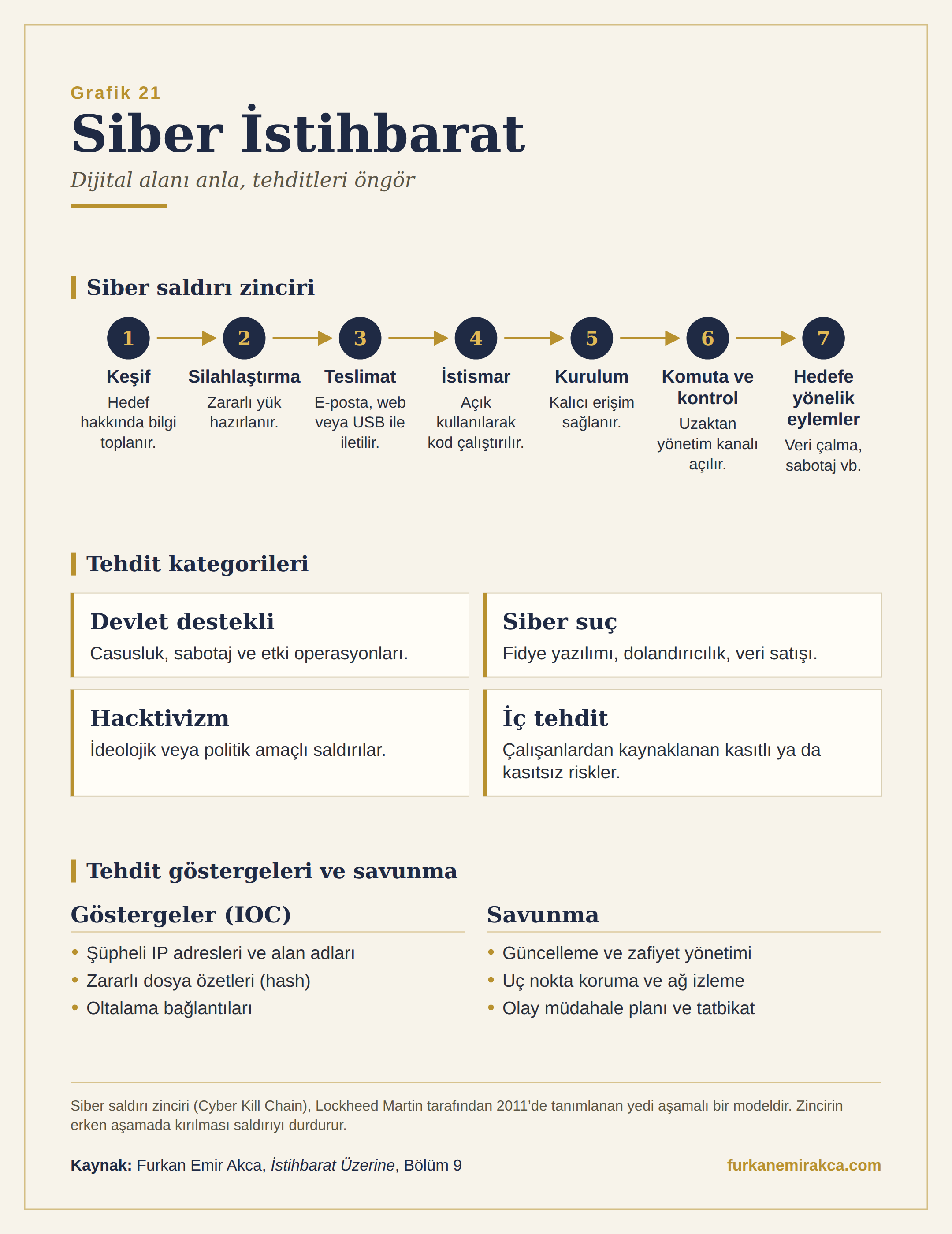
Cyber IntelligenceCyber Intelligence Understand the digital domain, anticipate threats The cyber kill chain 1. Reconnaissance: Information about the target is gathered. 2. Weaponisation: A malicious payload is prepared. 3. Delivery: Transmitted by e-mail, web or USB. 4. Exploitation: Code is executed using a vulnerability. 5. Installation: Persistent access is established. 6. Command and control: A remote management channel is opened. 7. Actions on objectives: Data theft, sabotage etc. Threat categories State-sponsored: Espionage, sabotage and influence operations. Cybercrime: Ransomware, fraud, sale of data. Hacktivism: Attacks with ideological or political aims. Insider threat: Intentional or unintentional risks originating from employees. Threat indicators and defence Indicators (IOC): Suspicious IP addresses and domain names; Malicious file hashes; Phishing links Defence: Updates and vulnerability management; Endpoint protection and network monitoring; Incident response plan and exercises Graphic 21 Cyber Intelligence Understand the digital domain, anticipate threats The cyber kill chain 1 Reconnaissance Target information about the target is gathered. 2 Weaponisation Malicious payload concisely. 3 Delivery Transmitted by e-mail, web or USB. 4 Exploitation Code is executed using a vulnerability. 5 Installation Persistent access is established. 6 Command and control A remote management channel is opened. 7 Actions on objectives Data theft, sabotage etc. Threat categories State-sponsored Espionage, sabotage and influence operations. Cybercrime Ransomware, fraud, sale of data. Hacktivism Attacks with ideological or political aims. Insider threat Intentional or unintentional risks originating from employees. Threat indicators and defence Indicators (IOC) Suspicious IP addresses and domain names Malicious file hashes Phishing links Defence Updates and vulnerability management Endpoint protection and network monitoring Incident response plan and exercises The Cyber Kill Chain is a seven-stage model defined by Lockheed Martin in 2011. Breaking the chain at an early stage stops the attack. Source: Furkan Emir Akca, İstihbarat Üzerine, Chapter 9 furkanemirakca.com

Open the graphic at full size · Download as PNG (2160×2800). You may use it for educational purposes with attribution.

Explanation

One of the commonly used models for understanding cyber attacks is the seven-stage cyber kill chain defined by Lockheed Martin in 2011: reconnaissance, weaponisation, delivery, exploitation, installation, command and control, and actions on objectives. Breaking the chain at an early stage stops the attack.

Cyber threats can be considered in four main categories: state-sponsored espionage and sabotage, cybercrime for financial gain, hacktivism with ideological aims, and insider threats originating from within the institution.

Threat indicators such as suspicious IP addresses, domain names, malicious file hashes and phishing links are used in the early detection of attacks. Defence, in turn, rests on updates and vulnerability management, endpoint protection, network monitoring and an incident response plan tested through exercises.

More in the book

✓ İSTİHBARAT ÜZERİNE

This subject is dealt with in detail in my book İstihbarat Üzerine under the heading Chapter 9 — Cyberspace and Digital Intelligence. The whole book can be read free of charge.

Open the relevant chapter in the PDF (p. 51) · Book page

Related concepts