⌕ Search
İstihbarat Üzerine/Intelligence Guide/How Does Intelligence Support Decisions?
GRAPHIC 12
Intelligence Guide — Analysis

How Does Intelligence Support Decisions?

The purpose of intelligence is to reduce uncertainty. Assessment sets out what the information means for the decision-maker; a decision is the choice of one of the options in the light of this assessment.
Prepared by: Furkan Emir Akca — based on the book İstihbarat Üzerine
In the book: Chapter 10 — Strategic Intelligence
Last updated: September 2026

✓ SHORT ANSWER

The purpose of intelligence is to reduce uncertainty. Assessment sets out what the information means for the decision-maker; a decision is the choice of one of the options in the light of this assessment.

Graphic

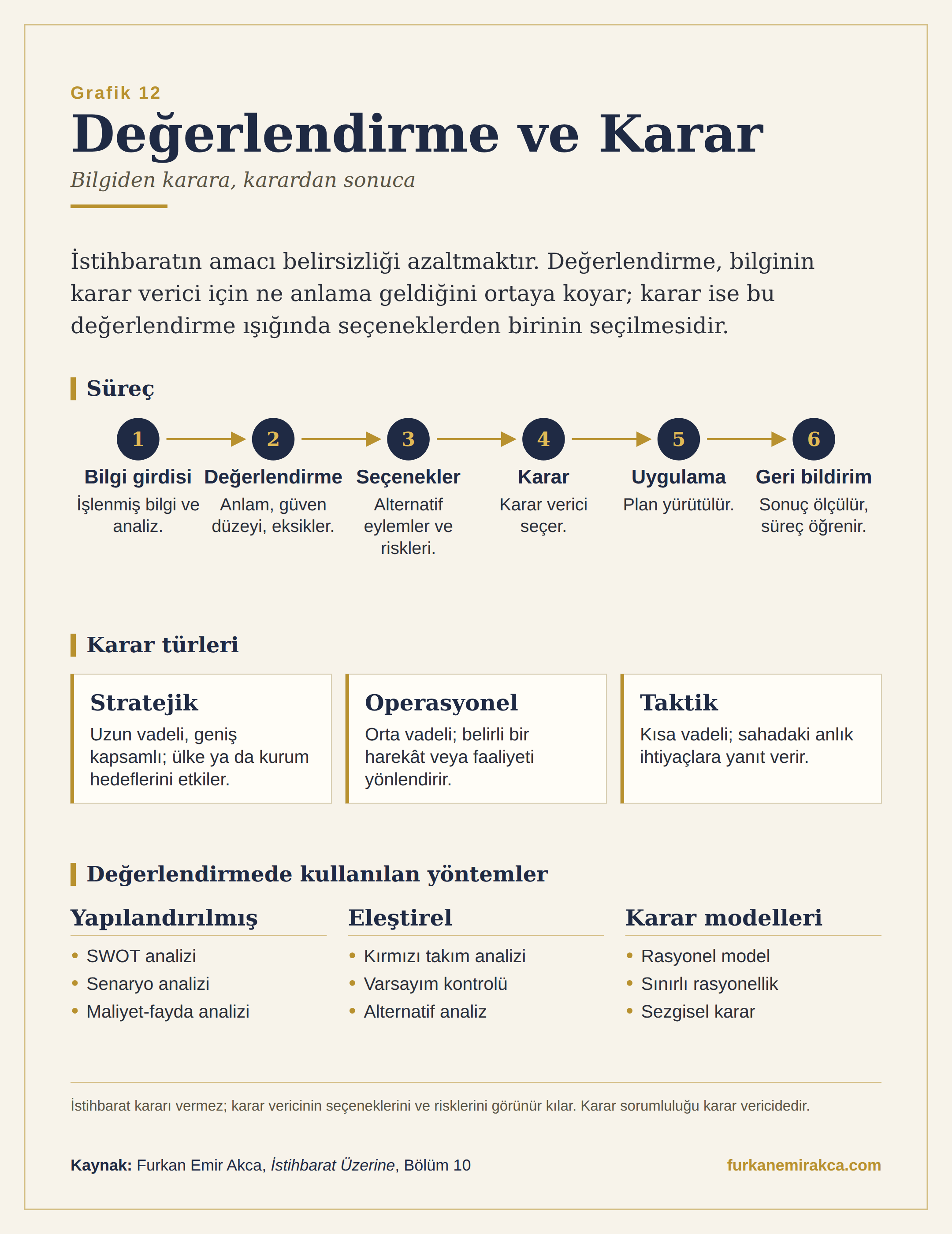
Assessment and DecisionAssessment and Decision From information to decision, from decision to outcome The purpose of intelligence is to reduce uncertainty. Assessment sets out what the information means for the decision-maker; a decision is the choice of one of the options in the light of this assessment. Process 1. Information input: Processed information and analysis. 2. Assessment: Meaning, level of confidence, gaps. 3. Options: Alternative actions and their risks. 4. Decision: The decision-maker chooses. 5. Implementation: The plan is carried out. 6. Feedback: The outcome is measured, the process learns. Types of decision Strategic: Long-term, broad in scope; affects the goals of a country or institution. Operational: Medium-term; directs a particular operation or activity. Tactical: Short-term; responds to immediate needs in the field. Methods used in assessment Structured: SWOT analysis; Scenario analysis; Cost-benefit analysis Critical: Red team analysis; Assumptions check; Alternative analysis Decision models: Rational model; Bounded rationality; Intuitive decision Graphic 12 Assessment and Decision From information to decision, from decision to outcome The purpose of intelligence is to reduce uncertainty. Assessment sets out what the information means for the decision-maker; a decision is the choice of one of the options in the light of this assessment. Process 1 Information input Processed information and analysis. 2 Assessment Meaning, level of confidence, gaps. 3 Options Alternative actions and their risks. 4 Karar The decision-maker chooses. 5 Implementation The plan is carried out. 6 Feedback The outcome is measured, the process learns. Types of decision Strategic Long-term, broad in scope; affects the goals of a country or institution. Operational Medium-term; directs a particular operation or activity. Tactical Short-term; responds to immediate needs in the field. Methods used in assessment Structured SWOT analysis Scenario analysis Cost-benefit analysis Critical Red team analysis Assumptions check Alternative analysis Decision models Rational model Bounded rationality Intuitive decision Intelligence does not make the decision; it makes the decision-maker’s options and risks visible. Responsibility for the decision lies with the decision-maker. Source: Furkan Emir Akca, İstihbarat Üzerine, Chapter 10 furkanemirakca.com

Open the graphic at full size · Download as PNG (2160×2800). You may use it for educational purposes with attribution.

Explanation

Intelligence does not make the decision; it makes the decision-maker’s options and risks visible. Responsibility for the decision always lies with the decision-maker. This distinction is also important for preventing intelligence from being shaped by political expectations.

Decisions are divided according to their scope into strategic, operational and tactical. Strategic decisions are long-term and broad in scope; operational decisions direct a particular operation; tactical decisions respond to immediate needs in the field.

In assessment methods such as SWOT, scenario analysis, cost-benefit analysis, red team analysis and assumptions checks are used. Which method is chosen depends on the type of question and the time available.

More in the book

✓ İSTİHBARAT ÜZERİNE

This subject is dealt with in detail in my book İstihbarat Üzerine under the heading Chapter 10 — Strategic Intelligence. The whole book can be read free of charge.

Open the relevant chapter in the PDF (p. 56) · Book page

Related concepts