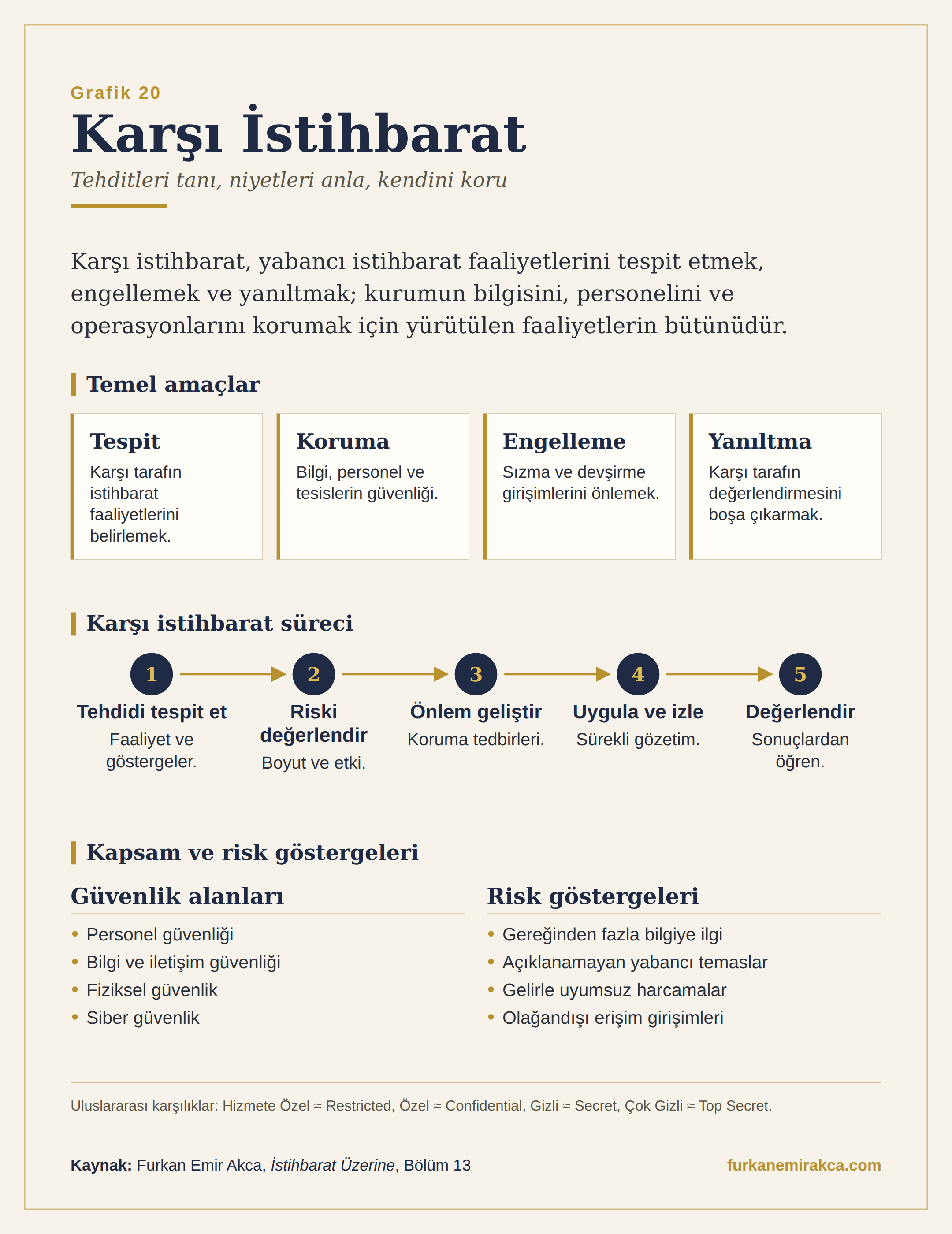
Counterintelligence is the whole of the activities carried out to detect, prevent and deceive foreign intelligence activities and to protect the institution’s information, personnel and operations.
Prepared by: Furkan Emir Akca — based on the book İstihbarat Üzerine
In the book: Chapter 13 — Counterintelligence
Last updated: September 2026
✓ SHORT ANSWER
Counterintelligence is the whole of the activities carried out to detect, prevent and deceive foreign intelligence activities and to protect the institution’s information, personnel and operations.
Counterintelligence has four basic aims: to detect the other side’s activities, to protect information and personnel, to prevent infiltration and recruitment attempts and, where necessary, to deceive the other side’s assessment.
The process begins with detecting the threat; it continues with assessing the risk, developing measures, implementing them and continuous monitoring. Personnel, information, physical and cyber security are the main areas of this process.
Interest in more information than necessary, unexplained foreign contacts, spending inconsistent with income and unusual access attempts are risk indicators frequently cited in the literature. In my book I also discuss the ethical limits of counterintelligence: security concerns cannot be a justification for practices contrary to the law and fundamental rights.
More in the book
✓ İSTİHBARAT ÜZERİNE
This subject is dealt with in detail in my book İstihbarat Üzerine under the heading Chapter 13 — Counterintelligence. The whole book can be read free of charge.
Note on method. Unless a final court judgment exists regarding persons named in these files, incriminating information is presented only together with its source and as an allegation. Detention, arrest or giving testimony does not imply guilt. The evidence labels indicate what a statement rests on, not a verdict on whether it is true.
This is an English translation. The Turkish original is the authoritative text: Türkçe asıl metin