⌕ Search
İstihbarat Üzerine/Intelligence Guide/What Is the Difference between Data, Information and Intelligence?
GRAPHIC 8
Intelligence Guide — Core concepts

What Is the Difference between Data, Information and Intelligence?

Data is raw observation, information is processed and interpreted data, and intelligence is information that has been analysed, put in context and carries meaning for the decision-maker. A decision is the choice of one of the options in the light of this assessment.
Prepared by: Furkan Emir Akca — based on the book İstihbarat Üzerine
In the book: Chapter 1 — The Concept and Foundations of Intelligence
Last updated: September 2026

✓ SHORT ANSWER

Data is raw observation, information is processed and interpreted data, and intelligence is information that has been analysed, put in context and carries meaning for the decision-maker. A decision is the choice of one of the options in the light of this assessment.

Graphic

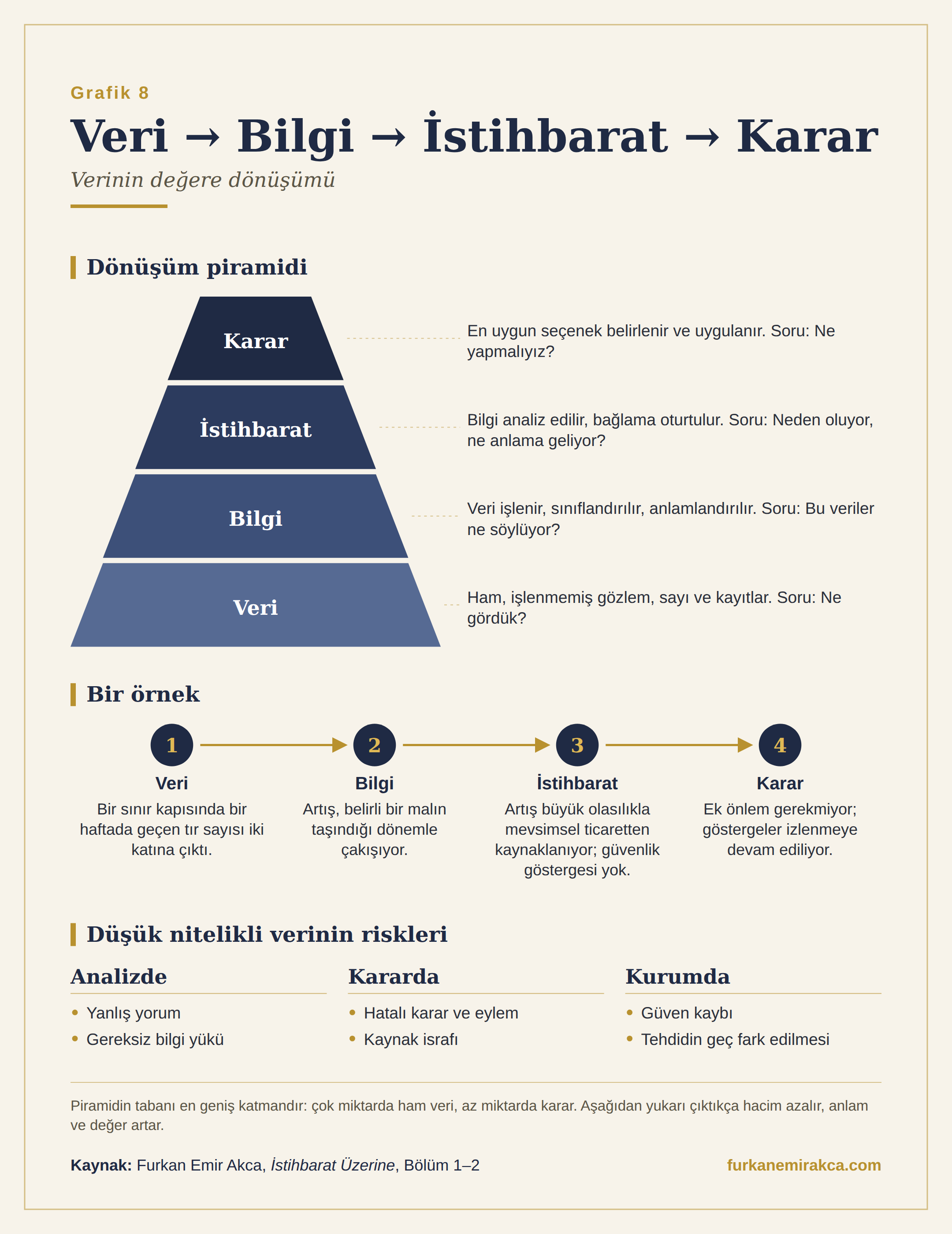
Data → Information → Intelligence → DecisionData → Information → Intelligence → Decision The transformation of data into value The transformation pyramid Decision: The most suitable option is identified and implemented. Question: What should we do? Intelligence: Information is analysed and put in context. Question: Why is it happening, what does it mean? Information: Data is processed, classified and interpreted. Question: What do these data say? Data: Raw, unprocessed observations, numbers and records. Question: What did we see? An example 1. Data: The number of lorries passing through a border crossing in a week doubled. 2. Information: The increase coincides with the period when a particular commodity is transported. 3. Intelligence: The increase very probably stems from seasonal trade; there is no security indicator. 4. Decision: No additional measures are needed; the indicators continue to be monitored. Risks of low-quality data In analysis: Wrong interpretation; Unnecessary information load In decisions: Wrong decision and action; Waste of resources In the institution: Loss of trust; Late recognition of the threat Graphic 8 Data → Information → Intelligence → Decision The transformation of data into value The transformation pyramid Karar The most suitable option is identified and implemented. Question: What should we do? Intelligence Information is analysed and put in context. Question: Why is it happening, what does it mean? Information Data is processed, classified and interpreted. Question: What do these data say? Data Raw, unprocessed observations, numbers and records. Question: What did we see? An example 1 Data The number of lorries passing through a border crossing in a week doubled. 2 Information The increase coincides with the period when a particular commodity is transported. 3 Intelligence The increase very probably stems from seasonal trade; there is no security indicator. 4 Karar No additional measures are needed; the indicators continue to be monitored. Risks of low-quality data In analysis Wrong interpretation Unnecessary information load In decisions Wrong decision and action Waste of resources In the institution Loss of trust Late recognition of the threat The base of the pyramid is the widest layer: a large amount of raw data, a small number of decisions. Moving from bottom to top, volume decreases while meaning and value increase. Source: Furkan Emir Akca, İstihbarat Üzerine, Chapters 1–2 furkanemirakca.com

Open the graphic at full size · Download as PNG (2160×2800). You may use it for educational purposes with attribution.

Explanation

This transformation can be thought of as a pyramid: at the base there is a large amount of raw data, at the top a small number of decisions. Moving up, volume decreases while meaning and value increase. Each layer answers a different question: What did we see? What do these data say? Why is it happening? What should we do?

In the example in the graphic, the doubling of the number of lorries passing through a border crossing is data. The fact that this increase coincides with the period when a particular commodity is transported is information. The assessment that the increase very probably stems from seasonal trade and carries no security indicator is intelligence. And deciding that no additional measures are needed but that the indicators will continue to be monitored is the decision.

Weakness in any link of the chain affects the following links. Low-quality data leads to wrong interpretations, wrong decisions, waste of resources and loss of trust in the institution.

More in the book

✓ İSTİHBARAT ÜZERİNE

This subject is dealt with in detail in my book İstihbarat Üzerine under the heading Chapter 1 — The Concept and Foundations of Intelligence. The whole book can be read free of charge.

Open the relevant chapter in the PDF (p. 10) · Book page

Related concepts