⌕ Search
İstihbarat Üzerine/Intelligence Guide/How Is Intelligence Analysis Done?
GRAPHIC 9
Intelligence Guide — Analysis

How Is Intelligence Analysis Done?

Intelligence analysis is the stage at which collected information gains meaning. The analyst examines connections, identifies trends, develops alternative explanations and assesses conclusions together with a level of confidence.
Prepared by: Furkan Emir Akca — based on the book İstihbarat Üzerine
In the book: Chapter 4 — Intelligence Analysis
Last updated: September 2026

✓ SHORT ANSWER

Intelligence analysis is the stage at which collected information gains meaning. The analyst examines connections, identifies trends, develops alternative explanations and assesses conclusions together with a level of confidence.

Graphic

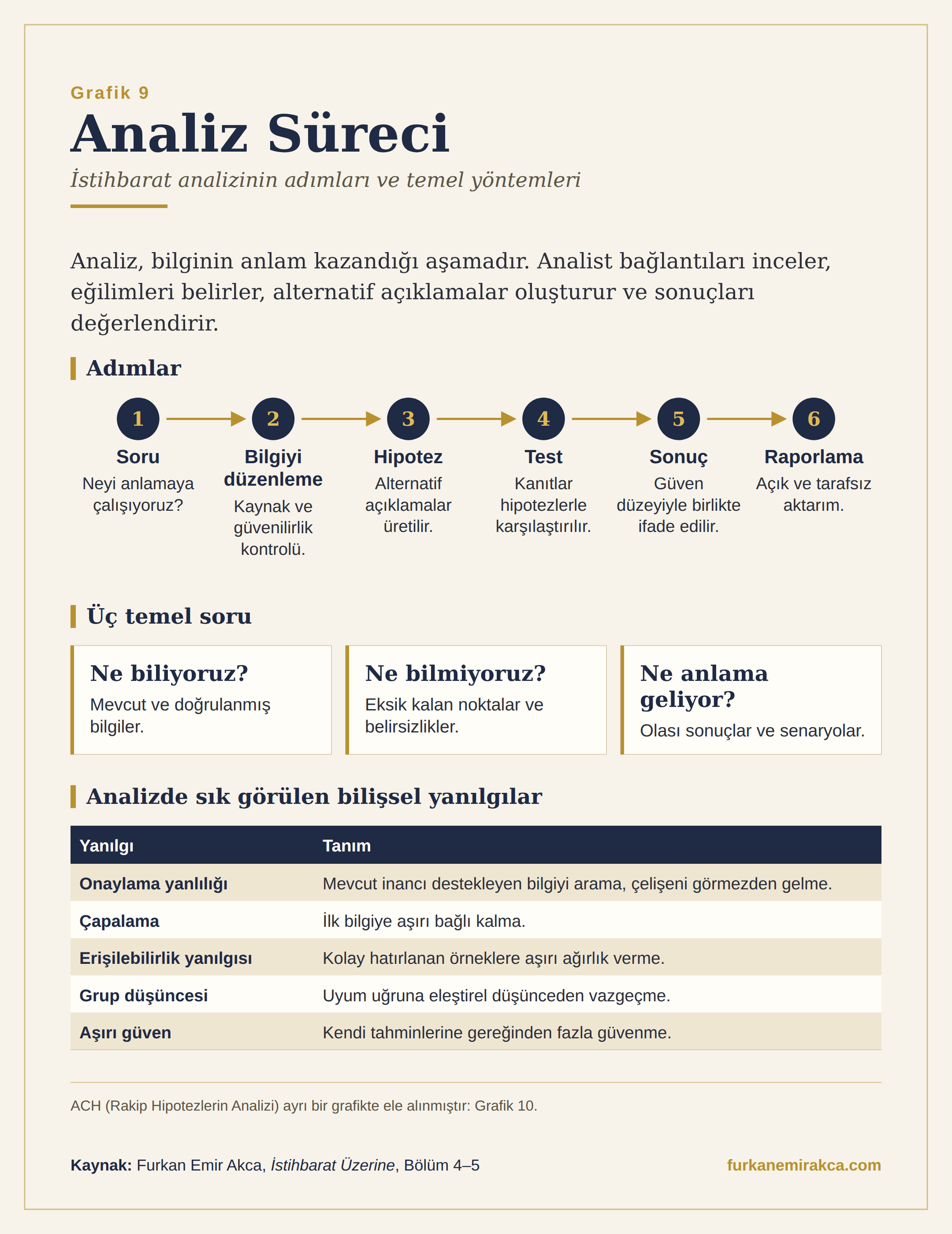
The Analysis ProcessThe Analysis Process The steps and basic methods of intelligence analysis Analysis is the stage at which information gains meaning. The analyst examines connections, identifies trends, develops alternative explanations and assesses conclusions. Steps 1. Question: What are we trying to understand? 2. Organising information: Checking source and reliability. 3. Hypothesis: Alternative explanations are generated. 4. Test: Evidence is compared against the hypotheses. 5. Conclusion: Stated together with a level of confidence. 6. Reporting: Clear and impartial transmission. Three basic questions What do we know?: Available and verified information. What don’t we know?: Gaps and uncertainties. What does it mean?: Possible consequences and scenarios. Common cognitive biases in analysis Confirmation bias | Seeking information that supports an existing belief and ignoring what contradicts it. Anchoring | Being overly attached to the first information. Availability bias | Giving too much weight to easily remembered examples. Groupthink | Abandoning critical thinking for the sake of conformity. Overconfidence | Trusting one’s own estimates more than warranted. Graphic 9 The Analysis Process The steps and basic methods of intelligence analysis Analysis is the stage at which information gains meaning. The analyst examines connections, identifies trends, develops alternative explanations and assesses conclusions. Steps 1 Question What are we trying to understand? 2 Organising information Checking source and reliability. 3 Hypothesis Alternative explanations are generated. 4 Test Evidence is compared against the hypotheses sources. 5 Outcome Stated together with a level of confidence. 6 Reporting Clear and impartial decision-maker. Three basic questions What do we know? Available and verified information. What don’t we know? Gaps and uncertainties. What does it mean? Possible consequences and scenarios. Common cognitive biases in analysis Bias Definition Confirmation bias Seeking information that supports an existing belief and ignoring what contradicts it. Anchoring Being overly attached to the first information. Availability bias Giving too much weight to easily remembered examples. Groupthink Abandoning critical thinking for the sake of conformity. Overconfidence Trusting one’s own estimates more than warranted. ACH (Analysis of Competing Hypotheses) is dealt with in a separate graphic: Graphic 10. Source: Furkan Emir Akca, İstihbarat Üzerine, Chapters 4–5 furkanemirakca.com

Open the graphic at full size · Download as PNG (2160×2800). You may use it for educational purposes with attribution.

Explanation

Analysis begins with a question: what are we trying to understand? Then information is organised and source reliability is checked; alternative hypotheses are generated, the evidence is tested against these hypotheses, and the conclusion is stated together with how certain one is.

In my book I describe analysis around three basic questions: What do we know? What don’t we know? What does it mean? The second question is often the most neglected; yet stating uncertainty openly is one of the most important signs of good analysis.

The greatest enemy of analysis is the analyst’s own mind. Confirmation bias, anchoring, availability bias, groupthink and overconfidence can mislead even the most experienced analysts. Structured techniques, especially the Analysis of Competing Hypotheses (ACH), were developed against these biases.

More in the book

✓ İSTİHBARAT ÜZERİNE

This subject is dealt with in detail in my book İstihbarat Üzerine under the heading Chapter 4 — Intelligence Analysis. The whole book can be read free of charge.

Open the relevant chapter in the PDF (p. 26) · Book page

Related concepts