✓ SHORT ANSWER
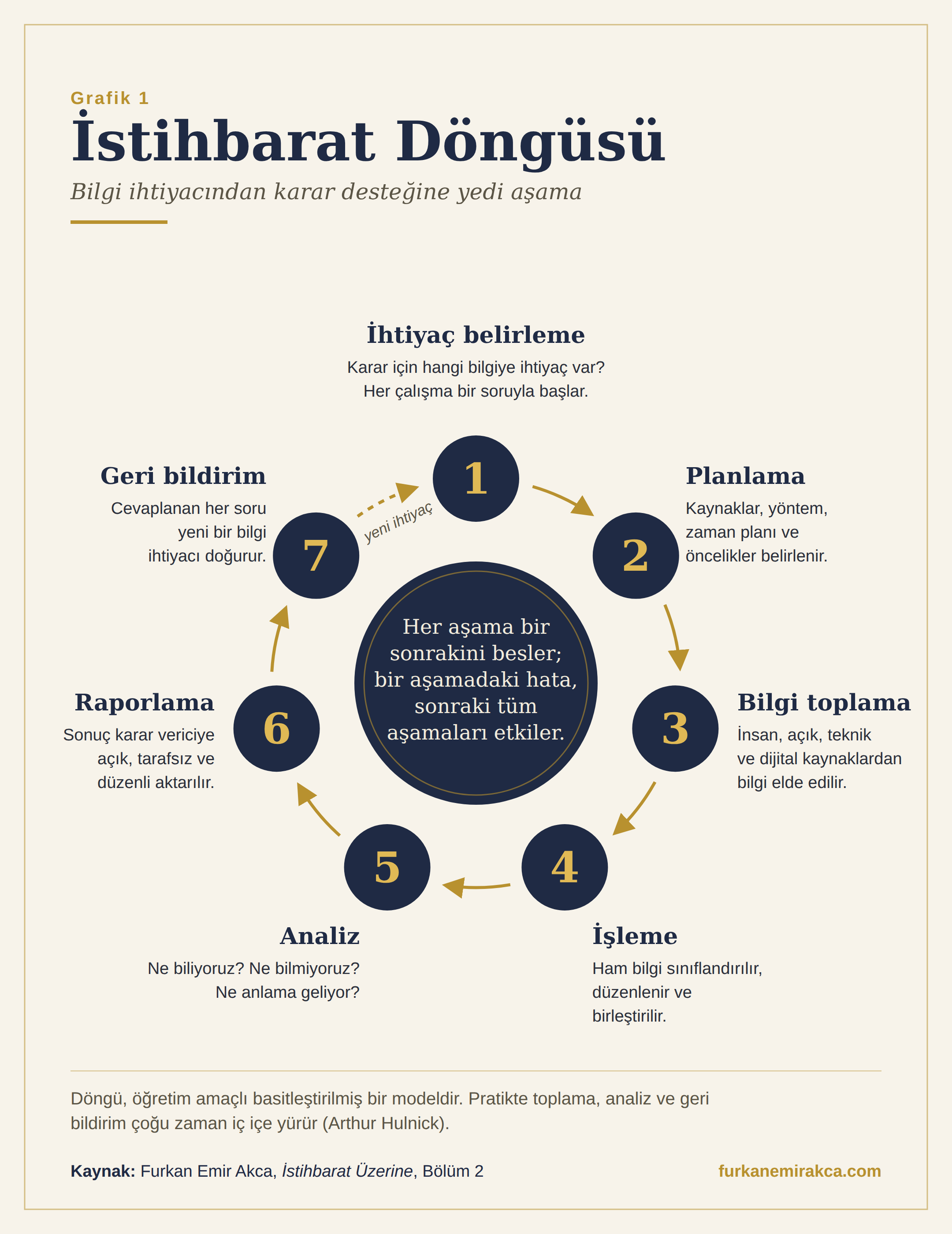
The intelligence cycle is the systematic process that runs from the emergence of an information need through the collection, processing and analysis of information to its presentation to the decision-maker. It consists of seven stages, and each stage feeds the next.
Graphic
Open the graphic at full size · Download as PNG (2160×2800). You may use it for educational purposes with attribution.
Explanation
The starting point of the cycle is always a question: what information is needed for which decision? A “let’s collect everything” approach leads to wasted time and an unnecessary information load. The right approach is to target the information needed to find the answer to a specific question.
In the planning stage resources, method, timetable and priorities are set. In the collection stage information is obtained from human, open, technical and digital sources. In the processing stage disorganised and incomplete raw information is classified, organised and made ready for analysis.
Analysis is the stage at which information gains meaning, and it is shaped around three questions: What do we know? What don’t we know? What does it mean? Reporting conveys the conclusion to the decision-maker clearly, impartially and in an orderly way. Feedback closes the cycle: every question answered usually gives rise to a new information need.
As I also emphasise in my book, this model is a framework simplified for teaching purposes. As researchers such as Arthur Hulnick have noted, in practice collection, analysis and feedback often run in parallel. Still, the cycle is a powerful tool for seeing the weak link of a piece of intelligence work: the strength of the cycle is determined not by its strongest stage but by its weakest.
More in the book
✓ İSTİHBARAT ÜZERİNE
This subject is dealt with in detail in my book İstihbarat Üzerine under the heading Chapter 2 — The Intelligence Cycle. The whole book can be read free of charge.