What Is the Difference between Data, Information and Intelligence?
Data is raw observation, information is processed and interpreted data, and intelligence is information that has been analysed, put in context and carries meaning for the decision-maker. A decision is the choice of one of the options in the light of this assessment.
Prepared by: Furkan Emir Akca — based on the book İstihbarat Üzerine
In the book: Chapter 1 — The Concept and Foundations of Intelligence
Last updated: September 2026
✓ SHORT ANSWER
Data is raw observation, information is processed and interpreted data, and intelligence is information that has been analysed, put in context and carries meaning for the decision-maker. A decision is the choice of one of the options in the light of this assessment.
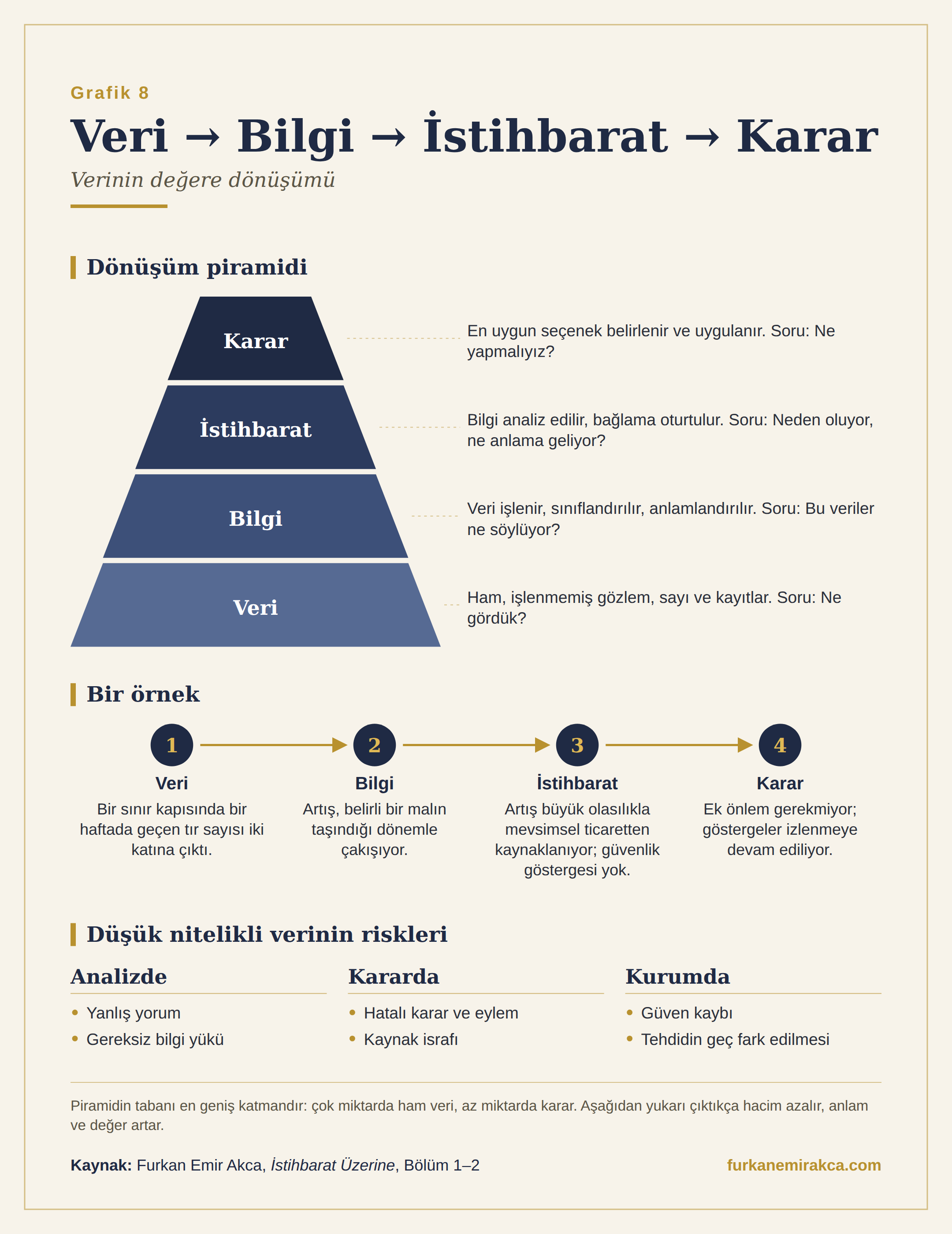
This transformation can be thought of as a pyramid: at the base there is a large amount of raw data, at the top a small number of decisions. Moving up, volume decreases while meaning and value increase. Each layer answers a different question: What did we see? What do these data say? Why is it happening? What should we do?
In the example in the graphic, the doubling of the number of lorries passing through a border crossing is data. The fact that this increase coincides with the period when a particular commodity is transported is information. The assessment that the increase very probably stems from seasonal trade and carries no security indicator is intelligence. And deciding that no additional measures are needed but that the indicators will continue to be monitored is the decision.
Weakness in any link of the chain affects the following links. Low-quality data leads to wrong interpretations, wrong decisions, waste of resources and loss of trust in the institution.
More in the book
✓ İSTİHBARAT ÜZERİNE
This subject is dealt with in detail in my book İstihbarat Üzerine under the heading Chapter 1 — The Concept and Foundations of Intelligence. The whole book can be read free of charge.
Note on method. Unless a final court judgment exists regarding persons named in these files, incriminating information is presented only together with its source and as an allegation. Detention, arrest or giving testimony does not imply guilt. The evidence labels indicate what a statement rests on, not a verdict on whether it is true.
This is an English translation. The Turkish original is the authoritative text: Türkçe asıl metin