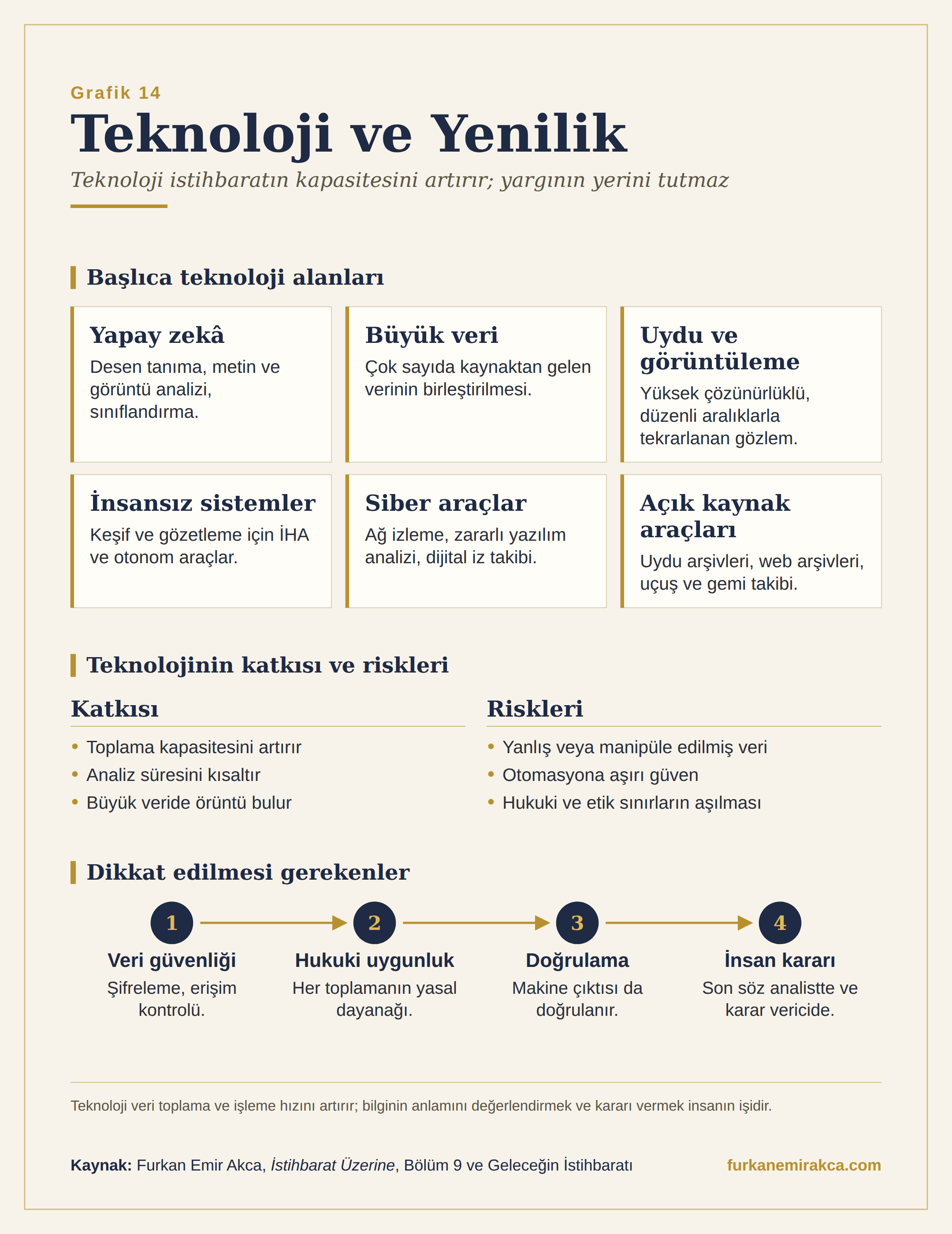
Technology greatly increases the collection and processing capacity of intelligence; but assessing the meaning of information and making the decision is still the work of people.
Prepared by: Furkan Emir Akca — based on the book İstihbarat Üzerine
In the book: Chapter 9 — Cyberspace and Digital Intelligence
Last updated: September 2026
✓ SHORT ANSWER
Technology greatly increases the collection and processing capacity of intelligence; but assessing the meaning of information and making the decision is still the work of people.
Artificial intelligence brings speed in pattern recognition and text and image analysis. Big data techniques make it possible to combine data from many sources. Satellites and unmanned systems expand observation capacity; open source tools, in turn, open part of this capacity to everyone.
The risks of technology are equally great: wrong or manipulated data, over-reliance on automation and overstepping legal and ethical limits. A machine output too should be verified just like a human source.
This is why, alongside technological capacity, the principles of data security, a legal basis for every collection and the final decision remaining with people must be upheld.
More in the book
✓ İSTİHBARAT ÜZERİNE
This subject is dealt with in detail in my book İstihbarat Üzerine under the heading Chapter 9 — Cyberspace and Digital Intelligence. The whole book can be read free of charge.
Note on method. Unless a final court judgment exists regarding persons named in these files, incriminating information is presented only together with its source and as an allegation. Detention, arrest or giving testimony does not imply guilt. The evidence labels indicate what a statement rests on, not a verdict on whether it is true.
This is an English translation. The Turkish original is the authoritative text: Türkçe asıl metin