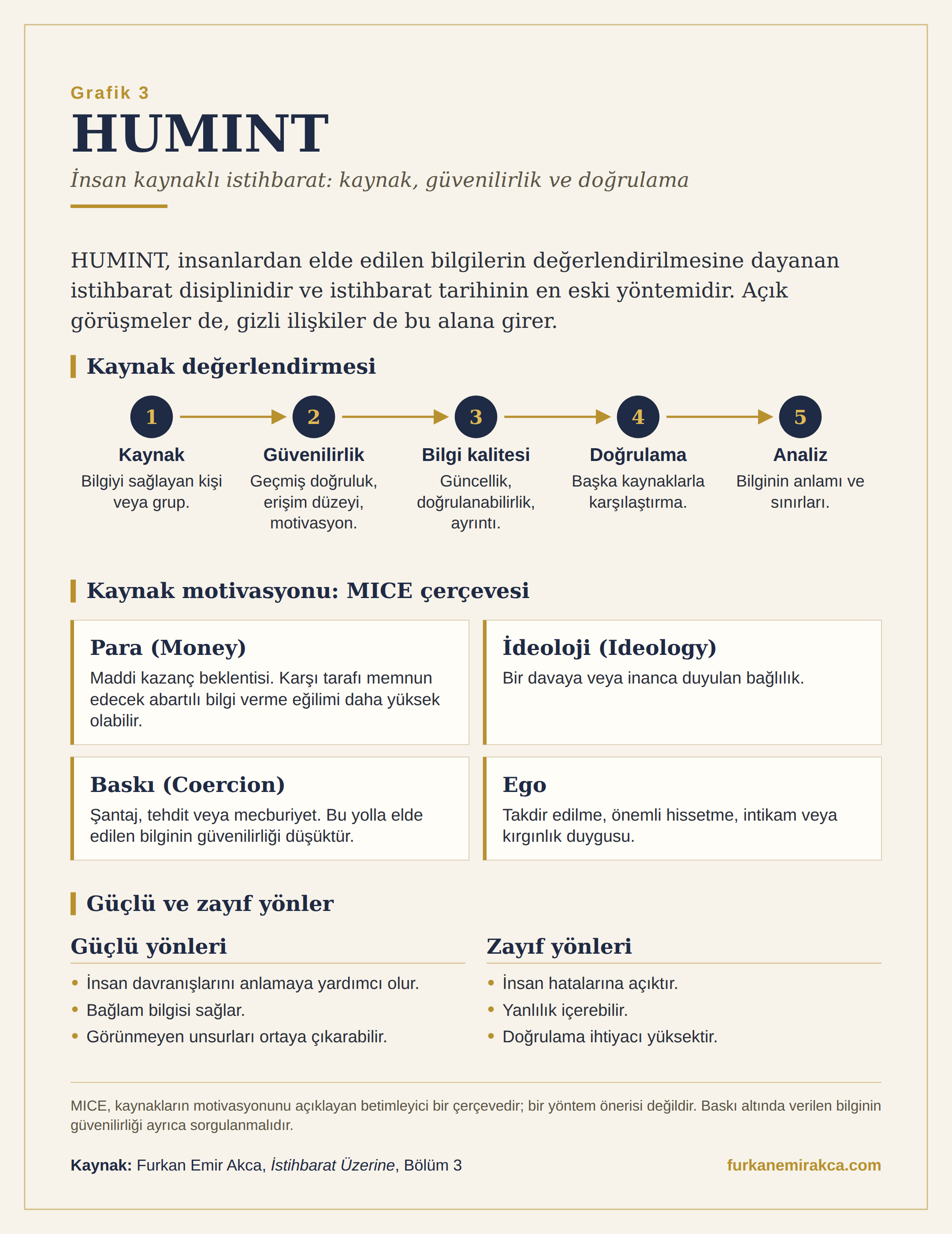
HUMINT (Human Intelligence) is the intelligence discipline based on assessing information obtained from people. It is the oldest method in the history of intelligence; both open interviews and covert relationships fall within this field.
Prepared by: Furkan Emir Akca — based on the book İstihbarat Üzerine
In the book: Chapter 3 — Intelligence Sources and Disciplines
Last updated: September 2026
✓ SHORT ANSWER
HUMINT (Human Intelligence) is the intelligence discipline based on assessing information obtained from people. It is the oldest method in the history of intelligence; both open interviews and covert relationships fall within this field.
In HUMINT the value of information depends largely on the source. In assessing a source, one looks at its past accuracy rate, level of access to the information and motivation. Even information from a reliable source should be examined separately for currency, verifiability and level of detail.
To understand why sources cooperate, the literature uses the MICE framework: Money, Ideology, Coercion and Ego. This framework is descriptive; it is not a method recommendation. Understanding motivation also determines how the information is to be interpreted. For example, a source seeking only material gain may have a higher tendency to give exaggerated information; the reliability of information given under coercion, on the other hand, should be questioned separately.
HUMINT is strong in understanding human behaviour and context; it can reveal elements that cannot be seen by other means. On the other hand it is open to human error and bias, so the need for verification is high.
More in the book
✓ İSTİHBARAT ÜZERİNE
This subject is dealt with in detail in my book İstihbarat Üzerine under the heading Chapter 3 — Intelligence Sources and Disciplines. The whole book can be read free of charge.
Note on method. Unless a final court judgment exists regarding persons named in these files, incriminating information is presented only together with its source and as an allegation. Detention, arrest or giving testimony does not imply guilt. The evidence labels indicate what a statement rests on, not a verdict on whether it is true.
This is an English translation. The Turkish original is the authoritative text: Türkçe asıl metin