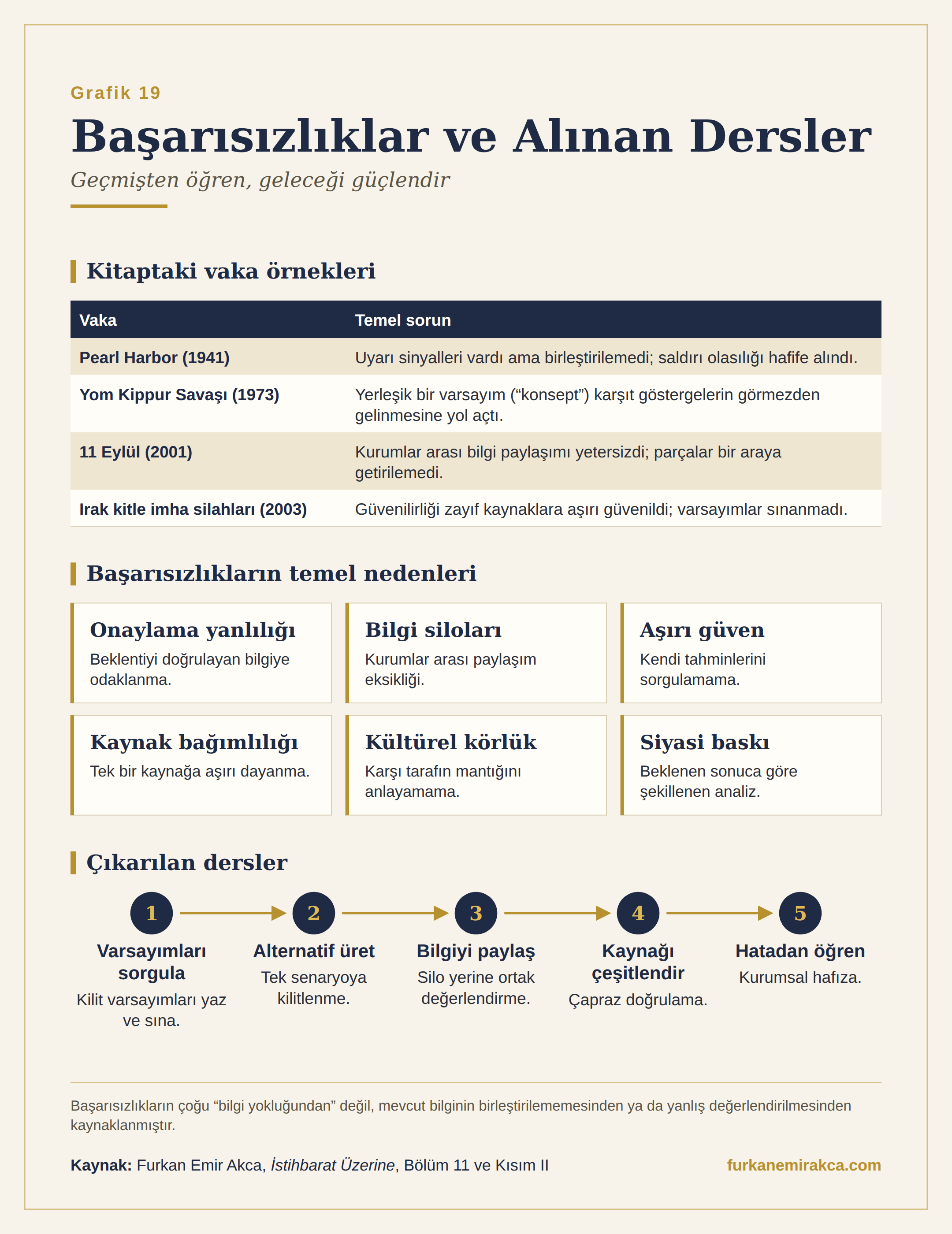
At Pearl Harbor (1941) there were warning signals but they could not be combined. In the Yom Kippur War (1973) an entrenched assumption led to contrary indicators being ignored. On 11 September (2001) information sharing between agencies was inadequate. In the assessment of Iraqi weapons of mass destruction (2003), excessive reliance was placed on sources of weak reliability and assumptions were not sufficiently tested.
The common causes of these cases are confirmation bias, information silos, overconfidence, dependence on a single source, cultural blindness and political pressure. In the second part of my book I examine these cases one by one, showing which link of the intelligence cycle broke.
The lessons learned are clear: writing down and testing assumptions, not locking onto a single scenario, sharing information, diversifying sources and building an institutional memory that learns from mistakes.
More in the book
✓ İSTİHBARAT ÜZERİNE
This subject is dealt with in detail in my book İstihbarat Üzerine under the heading Part II — Real Case Analyses. The whole book can be read free of charge.
Note on method. Unless a final court judgment exists regarding persons named in these files, incriminating information is presented only together with its source and as an allegation. Detention, arrest or giving testimony does not imply guilt. The evidence labels indicate what a statement rests on, not a verdict on whether it is true.
This is an English translation. The Turkish original is the authoritative text: Türkçe asıl metin