⌕ Search
İstihbarat Üzerine/Intelligence Guide/What Is ACH (Analysis of Competing Hypotheses)?
GRAPHIC 10
Intelligence Guide — Analysis

What Is ACH (Analysis of Competing Hypotheses)?

ACH (Analysis of Competing Hypotheses) is a structured analytic technique developed by CIA analyst Richards Heuer. All reasonable hypotheses are placed side by side and each piece of evidence is weighed for whether it is consistent with each hypothesis.
Prepared by: Furkan Emir Akca — based on the book İstihbarat Üzerine
In the book: Appendix — Practical Exercises: ACH Exercise
Last updated: September 2026

✓ SHORT ANSWER

ACH (Analysis of Competing Hypotheses) is a structured analytic technique developed by CIA analyst Richards Heuer. All reasonable hypotheses are placed side by side and each piece of evidence is weighed for whether it is consistent with each hypothesis.

Graphic

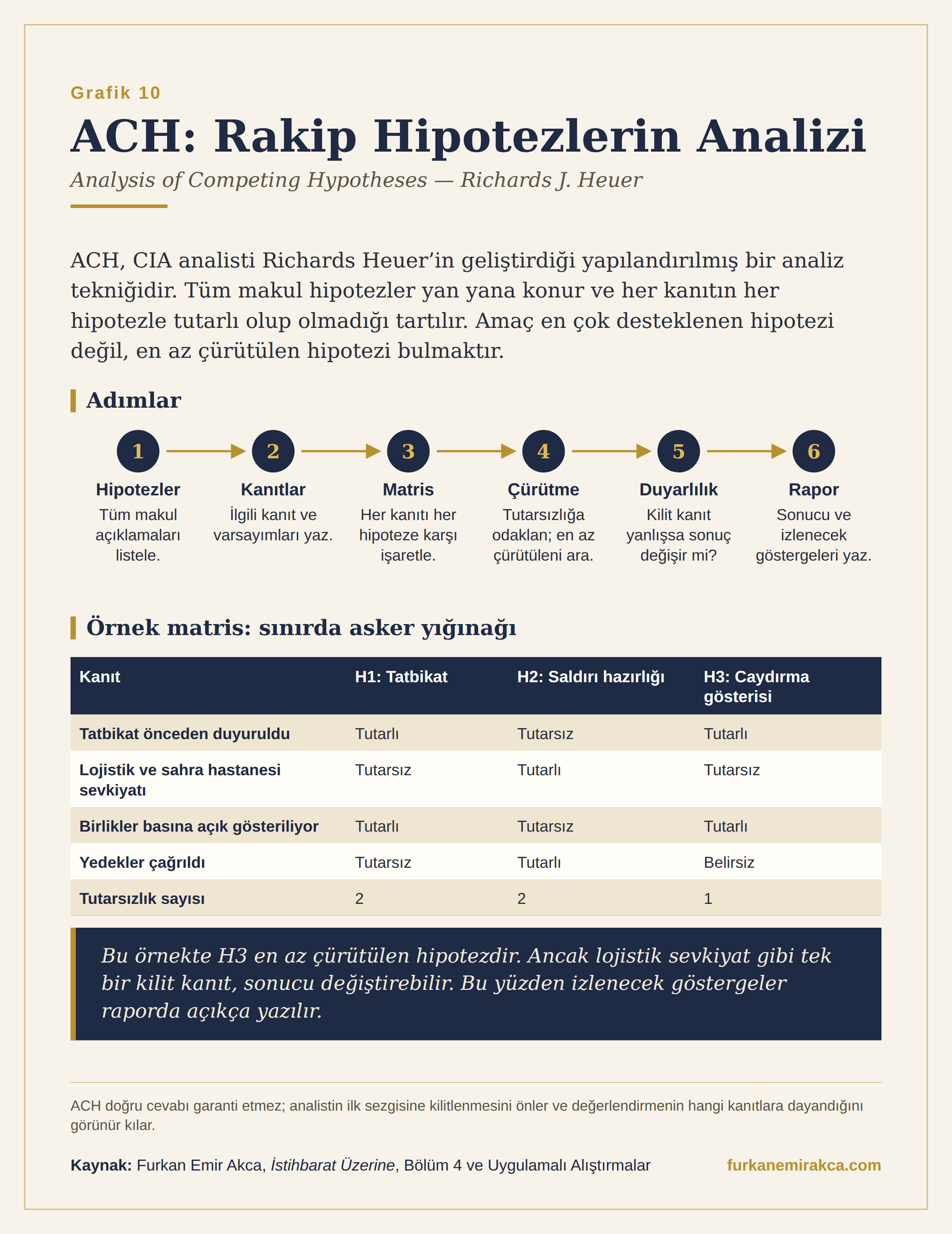
ACH: Analysis of Competing HypothesesACH: Analysis of Competing Hypotheses Analysis of Competing Hypotheses — Richards J. Heuer ACH is a structured analytic technique developed by CIA analyst Richards Heuer. All reasonable hypotheses are placed side by side and each piece of evidence is weighed for whether it is consistent with each hypothesis. The aim is to find not the most supported hypothesis but the least refuted one. Steps 1. Hypotheses: List all reasonable explanations. 2. Evidence: Write down the relevant evidence and assumptions. 3. Matrix: Mark each piece of evidence against each hypothesis. 4. Refutation: Focus on inconsistency; look for the least refuted. 5. Sensitivity: Does the conclusion change if a key piece of evidence is wrong? 6. Report: Write down the conclusion and the indicators to be monitored. Example matrix: troop build-up at the border Exercise announced in advance | Consistent | Inconsistent | Consistent Logistics and field hospital deployment | Inconsistent | Consistent | Inconsistent Troops shown openly to the press | Consistent | Inconsistent | Consistent Reserves called up | Inconsistent | Consistent | Unclear Number of inconsistencies | 2 | 2 | 1 In this example H3 is the least refuted hypothesis. But a single key piece of evidence such as the logistics deployment can change the conclusion. This is why the indicators to be monitored are written openly in the report. Graphic 10 ACH: Analysis of Competing Hypotheses Analysis of Competing Hypotheses — Richards J. Heuer ACH is a structured analytic technique developed by CIA analyst Richards Heuer. All reasonable hypotheses are placed side by side and each piece of evidence is weighed for whether it is consistent with each hypothesis. The aim is to find not the most supported hypothesis but the least refuted one. Steps 1 Hypotheses List all reasonable explanations. 2 Evidence is compared Write down the relevant evidence and assumptions. 3 Matrix Mark each piece of evidence against each hypothesis. 4 Refutation Focus on inconsistency; look for the least refuted. 5 Sensitivity If a key piece of evidence is wrong, does the conclusion change? 6 Report Write down the conclusion and the indicators to be monitored. Example matrix: troop build-up at the border Evidence H1: Exercise H2: Preparation for attack H3: Show of deterrence Exercise announced in advance Consistent Inconsistent Consistent Logistics and field hospital deployment Inconsistent Consistent Inconsistent Troops shown openly to the press Consistent Inconsistent Consistent Reserves called up Inconsistent Consistent Unclear Number of inconsistencies 2 2 1 In this example H3 is the least refuted hypothesis. But a single key piece of evidence such as the logistics deployment can change the conclusion. This is why the indicators to be monitored are written openly in the report. ACH does not guarantee the right answer; it prevents the analyst from locking onto their first intuition and makes visible which evidence the assessment rests on. Source: Furkan Emir Akca, İstihbarat Üzerine, Chapter 4 and Practical Exercises furkanemirakca.com

Open the graphic at full size · Download as PNG (2160×2800). You may use it for educational purposes with attribution.

Explanation

The basic idea of ACH is this: analysts usually look for evidence supporting the first explanation that comes to mind. ACH does the opposite and looks not for the most supported hypothesis but for the least refuted. Because many pieces of evidence are compatible with more than one hypothesis and are not diagnostic; the real information lies in evidence that contradicts a hypothesis.

In practice all reasonable hypotheses are first listed, then the relevant evidence and assumptions are written down. In a matrix each piece of evidence is marked against each hypothesis as “consistent”, “inconsistent” or “unclear”. The hypothesis with the fewest inconsistencies comes to the fore. In the last step a sensitivity test is carried out: if a key piece of evidence turns out to be wrong, does the conclusion change?

In the example in the graphic three hypotheses are tested for a troop build-up at the border: an exercise, preparation for attack and a show of deterrence. ACH does not guarantee the right answer; but it prevents the analyst from locking onto their first intuition and makes visible which evidence the assessment rests on. The practical exercises section of the book also contains a step-by-step ACH exercise.

More in the book

✓ İSTİHBARAT ÜZERİNE

This subject is dealt with in detail in my book İstihbarat Üzerine under the heading Appendix — Practical Exercises: ACH Exercise. The whole book can be read free of charge.

Open the relevant chapter in the PDF (p. 84) · Book page

Related concepts