⌕ Search
İstihbarat Üzerine/Intelligence Guide/Why Is Coordination Important in Intelligence?
GRAPHIC 13
Intelligence Guide — Product and ethics

Why Is Coordination Important in Intelligence?

Even the best analysis produces no value if it does not reach the right person in time. Coordination brings together the information and efforts of different units directed at the same target.
Prepared by: Furkan Emir Akca — based on the book İstihbarat Üzerine
In the book: Chapter 14 — Intelligence Agencies and Structures
Last updated: September 2026

✓ SHORT ANSWER

Even the best analysis produces no value if it does not reach the right person in time. Coordination brings together the information and efforts of different units directed at the same target.

Graphic

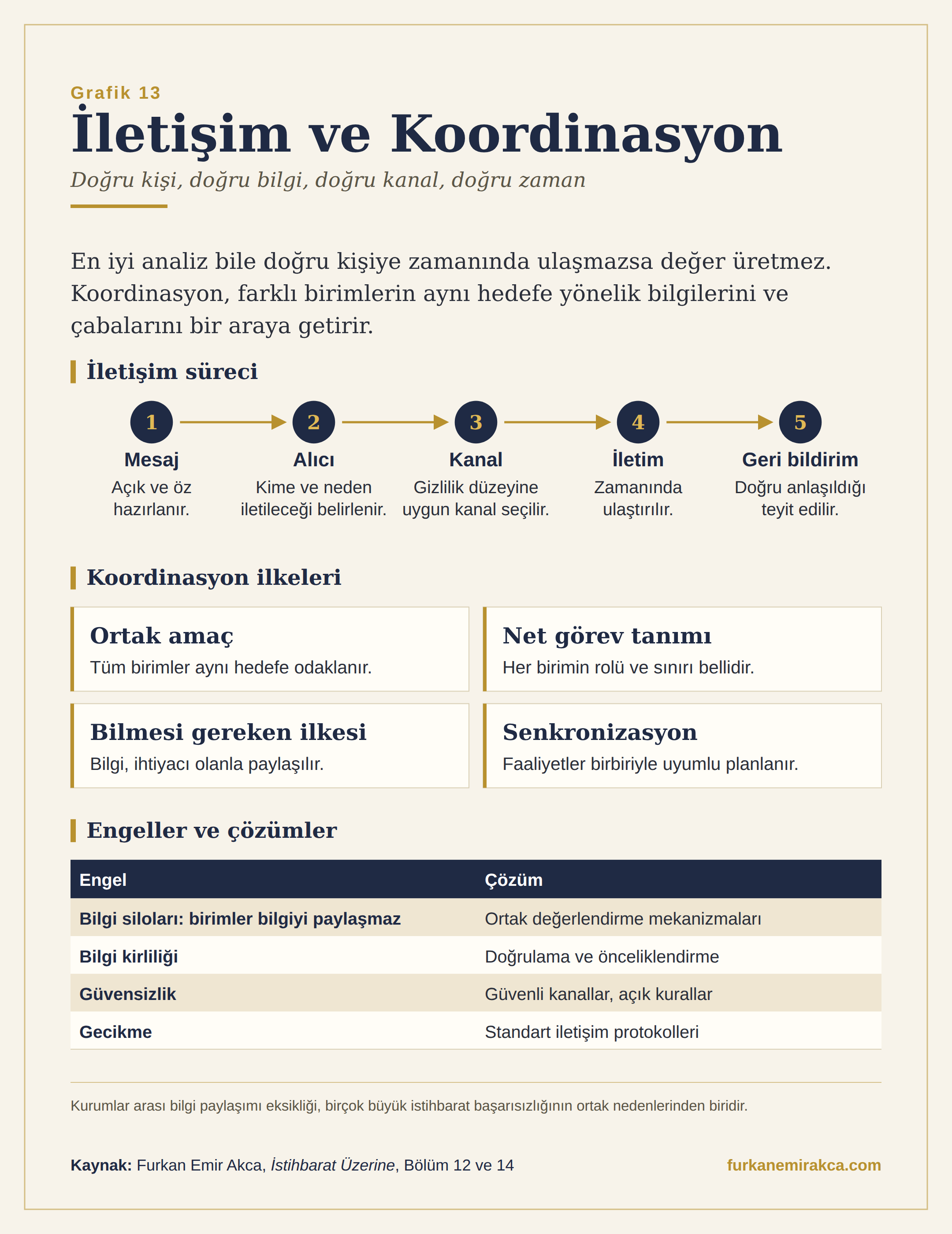
Communication and CoordinationCommunication and Coordination The right person, the right information, the right channel, the right time Even the best analysis produces no value if it does not reach the right person in time. Coordination brings together the information and efforts of different units directed at the same target. The communication process 1. Message: Prepared clearly and concisely. 2. Recipient: To whom and why it is to be sent is determined. 3. Channel: A channel suited to the classification level is chosen. 4. Transmission: Delivered on time. 5. Feedback: It is confirmed that it was understood correctly. Principles of coordination Common purpose: All units focus on the same target. Clear task definition: The role and limits of each unit are clear. Need-to-know principle: Information is shared with those who need it. Synchronisation: Activities are planned to be compatible with each other. Obstacles and solutions Information silos: units do not share information | Joint assessment mechanisms Information pollution | Verification and prioritisation Distrust | Secure channels, clear rules Delay | Standard communication protocols Graphic 13 Communication and Coordination The right person, the right information, the right channel, the right time Even the best analysis produces no value if it does not reach the right person in time. Coordination brings together the information and efforts of different units directed at the same target. The communication process 1 Message Prepared clearly and concisely. 2 Recipient To whom and why it is to be sent is determined. 3 Channel A channel suited to the classification level is chosen. 4 Transmission Delivered on time. 5 Feedback It is confirmed that it was understood correctly. Principles of coordination Common purpose All units focus on the same target. Clear task definition The role and limits of each unit are clear. Need-to-know principle Information is shared with those who need it. Synchronisation Activities are planned to be compatible with each other. Obstacles and solutions Obstacle Solution Information silos: units do not share information Joint assessment mechanisms Information pollution Verification and prioritisation Distrust Secure channels, clear rules Delay Standard communication protocols A lack of information sharing between agencies is one of the common causes of many major intelligence failures. Source: Furkan Emir Akca, İstihbarat Üzerine, Chapters 12 and 14 furkanemirakca.com

Open the graphic at full size · Download as PNG (2160×2800). You may use it for educational purposes with attribution.

Explanation

The communication process begins with preparing the message clearly and concisely; it is completed by determining the recipient and a channel suited to the classification level, timely transmission and confirmation that it was understood correctly.

As I also discuss in the agencies chapter of my book, models that distribute foreign and domestic intelligence among separate agencies provide strong specialisation; but they also bring the risk that information is not shared between agencies. This problem of “information silos” is one of the common causes of many major intelligence failures.

The solution lies in joint assessment mechanisms, clear task definitions, balanced application of the “need-to-know” principle and standard communication protocols.

More in the book

✓ İSTİHBARAT ÜZERİNE

This subject is dealt with in detail in my book İstihbarat Üzerine under the heading Chapter 14 — Intelligence Agencies and Structures. The whole book can be read free of charge.

Open the relevant chapter in the PDF (p. 74) · Book page

Related concepts