⌕ Search
İstihbarat Üzerine/Intelligence Guide/Why Do Intelligence Failures Happen?
GRAPHIC 19
Intelligence Guide — Institutions and the future

Why Do Intelligence Failures Happen?

Most intelligence failures result not from a lack of information but from a failure to combine existing information or from assessing it wrongly.
Prepared by: Furkan Emir Akca — based on the book İstihbarat Üzerine
In the book: Part II — Real Case Analyses
Last updated: September 2026

✓ SHORT ANSWER

Most intelligence failures result not from a lack of information but from a failure to combine existing information or from assessing it wrongly.

Graphic

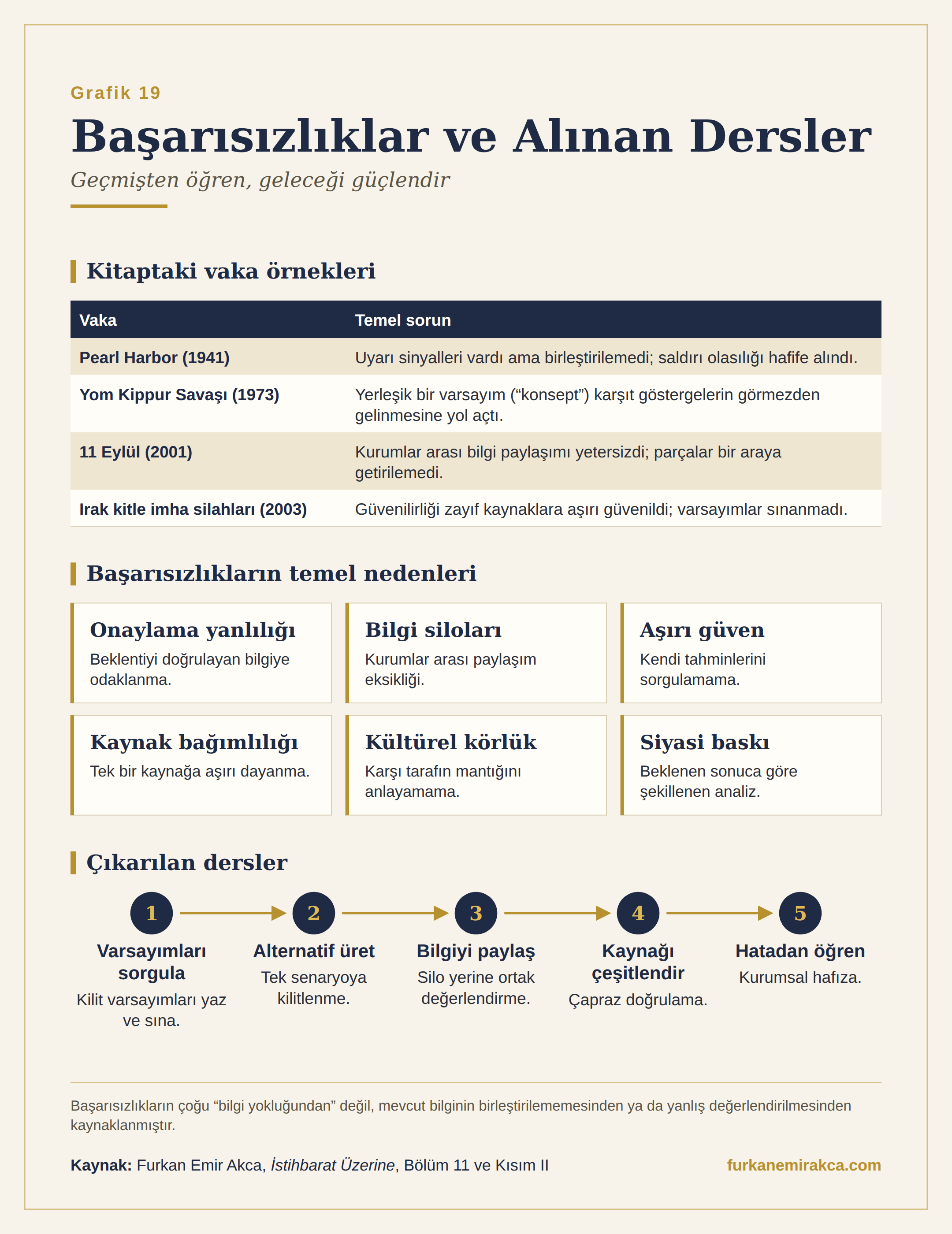
Failures and Lessons LearnedFailures and Lessons Learned Learn from the past, strengthen the future Case examples in the book Pearl Harbor (1941) | There were warning signals but they could not be combined; the likelihood of an attack was underestimated. The Yom Kippur War (1973) | An entrenched assumption (“the concept”) led to contrary indicators being ignored. 11 September (2001) | Information sharing between agencies was inadequate; the pieces could not be put together. Iraqi weapons of mass destruction (2003) | Excessive reliance was placed on sources of weak reliability; assumptions were not tested. Root causes of failures Confirmation bias: Focusing on information that confirms expectations. Information silos: Lack of sharing between agencies. Overconfidence: Not questioning one’s own estimates. Source dependence: Relying excessively on a single source. Cultural blindness: Failing to understand the other side’s logic. Political pressure: Analysis shaped by the expected outcome. Lessons learned 1. Question assumptions: Write down and test key assumptions. 2. Generate alternatives: Do not lock onto a single scenario. 3. Share information: Joint assessment instead of silos. 4. Diversify sources: Cross-verification. 5. Learn from mistakes: Institutional memory. Graphic 19 Failures and Lessons Learned Learn from the past, strengthen the future Case examples in the book Case Core problem Pearl Harbor (1941) There were warning signals but they could not be combined; the likelihood of an attack was underestimated. The Yom Kippur War (1973) An entrenched assumption (“the concept”) led to contrary indicators being ignored. 11 September (2001) Information sharing between agencies was inadequate; the pieces could not be put together. Iraqi weapons of mass destruction (2003) Excessive reliance was placed on sources of weak reliability; assumptions were not tested. Root causes of failures Confirmation bias Focusing on information that confirms expectations. Information silos Lack of sharing between agencies. Overconfidence Not questioning one’s own estimates. Source dependence Relying excessively on a single source. Cultural blindness Failing to understand the other side’s logic. Political pressure Analysis shaped by the expected outcome. Lessons learned 1 Question assumptions Write down key assumptions and test them. 2 Generate alternatives Do not lock onto a single scenario. 3 Share information Joint assessment instead of silos. 4 Diversify sources Cross-verification. 5 Learn from mistakes Institutional memory. Most failures have stemmed not from “a lack of information” but from a failure to combine existing information or from assessing it wrongly. Source: Furkan Emir Akca, İstihbarat Üzerine, Chapter 11 and Part II furkanemirakca.com

Open the graphic at full size · Download as PNG (2160×2800). You may use it for educational purposes with attribution.

Explanation

At Pearl Harbor (1941) there were warning signals but they could not be combined. In the Yom Kippur War (1973) an entrenched assumption led to contrary indicators being ignored. On 11 September (2001) information sharing between agencies was inadequate. In the assessment of Iraqi weapons of mass destruction (2003), excessive reliance was placed on sources of weak reliability and assumptions were not sufficiently tested.

The common causes of these cases are confirmation bias, information silos, overconfidence, dependence on a single source, cultural blindness and political pressure. In the second part of my book I examine these cases one by one, showing which link of the intelligence cycle broke.

The lessons learned are clear: writing down and testing assumptions, not locking onto a single scenario, sharing information, diversifying sources and building an institutional memory that learns from mistakes.

More in the book

✓ İSTİHBARAT ÜZERİNE

This subject is dealt with in detail in my book İstihbarat Üzerine under the heading Part II — Real Case Analyses. The whole book can be read free of charge.

Open the relevant chapter in the PDF (p. 109) · Book page

Related concepts