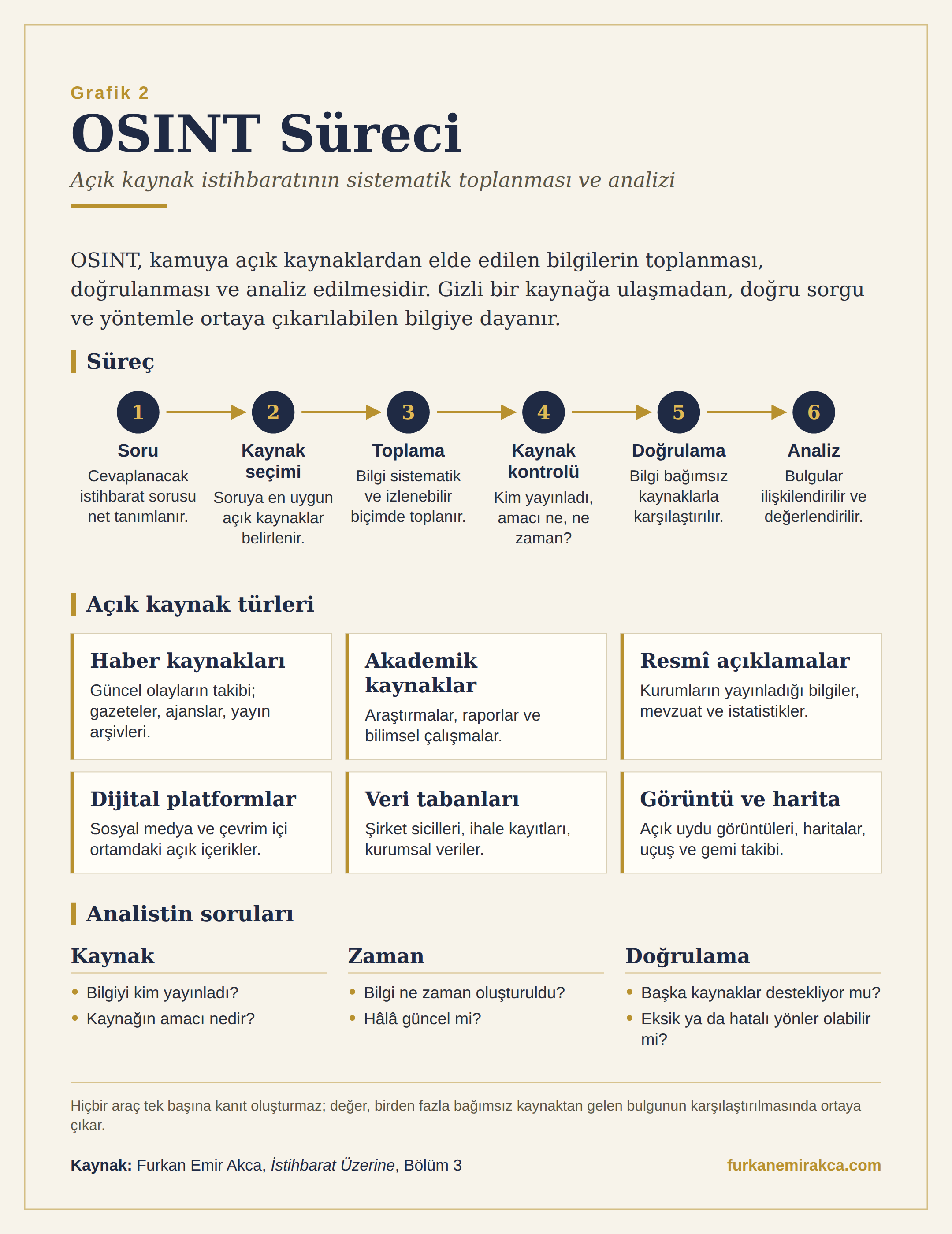
OSINT (Open Source Intelligence) is the collection, verification and analysis of information obtained from publicly available sources. News, academic studies, official statements, digital platforms and open databases are its main sources.
Prepared by: Furkan Emir Akca — based on the book İstihbarat Üzerine
In the book: Chapter 3 — Intelligence Sources and Disciplines
Last updated: September 2026
✓ SHORT ANSWER
OSINT (Open Source Intelligence) is the collection, verification and analysis of information obtained from publicly available sources. News, academic studies, official statements, digital platforms and open databases are its main sources.
In the digital age most of the publicly available information about a person or institution can be uncovered with the right query and analysis methods, without access to a secret source. This is why OSINT occupies an increasingly central place in intelligence work; it is also widely used in journalism and civil research.
The real difficulty of OSINT is not reaching information but assessing the information reached. For each piece of information the analyst asks these questions: Who published the information? What is the source’s purpose? When was the information created? Do other sources support it? Could there be missing or erroneous aspects?
Free tools such as satellite imagery, web archives, flight and ship tracking services and reverse image search are available to everyone today. But none of these tools constitutes evidence on its own; their value emerges in comparing findings from more than one independent source.
More in the book
✓ İSTİHBARAT ÜZERİNE
This subject is dealt with in detail in my book İstihbarat Üzerine under the heading Chapter 3 — Intelligence Sources and Disciplines. The whole book can be read free of charge.
Note on method. Unless a final court judgment exists regarding persons named in these files, incriminating information is presented only together with its source and as an allegation. Detention, arrest or giving testimony does not imply guilt. The evidence labels indicate what a statement rests on, not a verdict on whether it is true.
This is an English translation. The Turkish original is the authoritative text: Türkçe asıl metin