⌕ Search
GRAPHIC 5
Intelligence Guide — Collection disciplines

What Is IMINT?

IMINT (Imagery Intelligence) is the intelligence discipline produced by analysing images obtained from satellites, aircraft and other platforms.
Prepared by: Furkan Emir Akca — based on the book İstihbarat Üzerine
In the book: Chapter 3 — Intelligence Sources and Disciplines
Last updated: September 2026

✓ SHORT ANSWER

IMINT (Imagery Intelligence) is the intelligence discipline produced by analysing images obtained from satellites, aircraft and other platforms.

Graphic

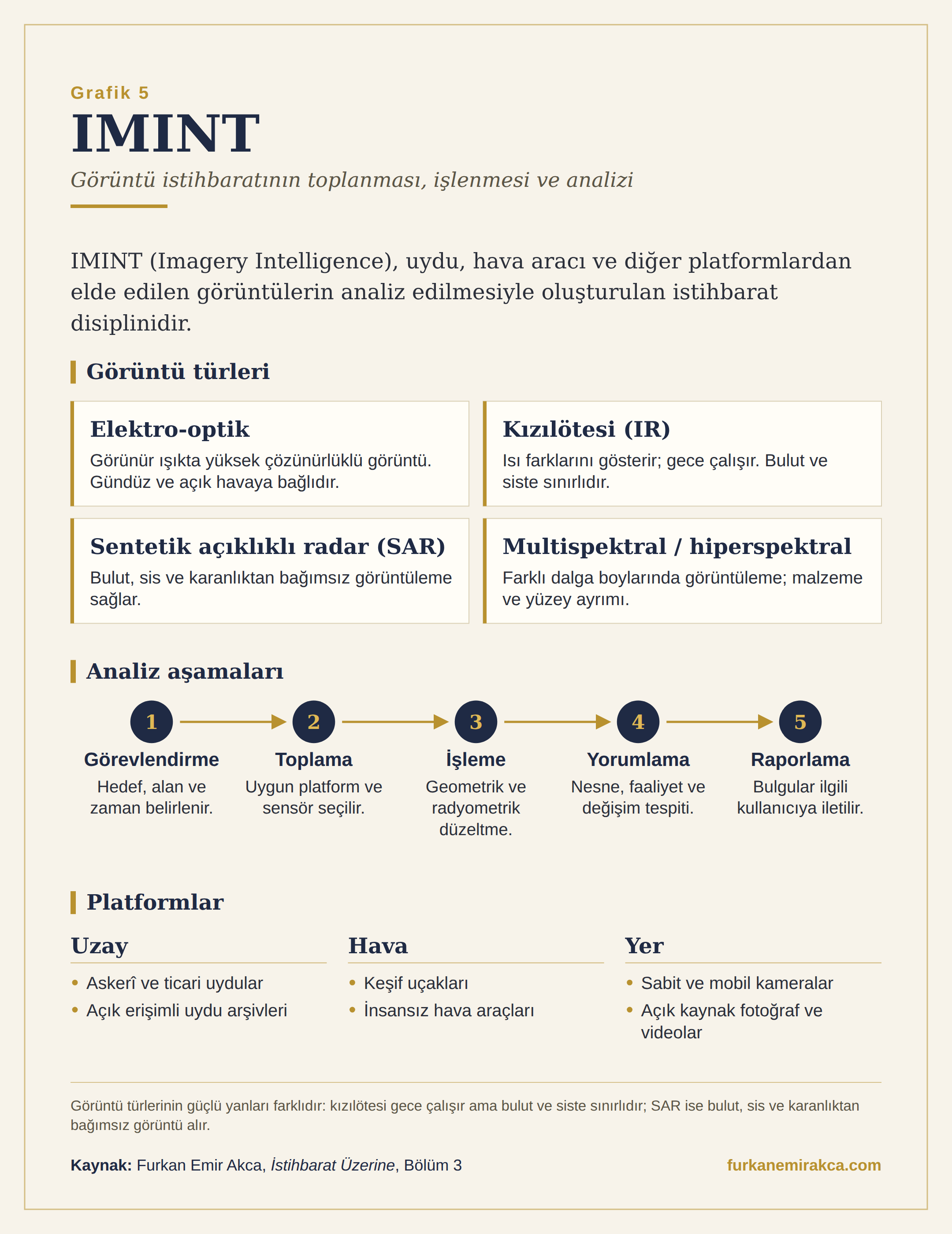
IMINTIMINT Collection, processing and analysis of imagery intelligence IMINT (Imagery Intelligence) is the intelligence discipline produced by analysing images obtained from satellites, aircraft and other platforms. Types of imagery Electro-optical: High-resolution imagery in visible light. Depends on daylight and clear weather. Infrared (IR): Shows heat differences; works at night. Limited in cloud and fog. Synthetic aperture radar (SAR): Provides imaging independent of cloud, fog and darkness. Multispectral / hyperspectral: Imaging at different wavelengths; distinguishing materials and surfaces. Stages of analysis 1. Tasking: Target, area and time are set. 2. Collection: A suitable platform and sensor are selected. 3. Processing: Geometric and radiometric correction. 4. Interpretation: Detection of objects, activity and change. 5. Reporting: Findings are passed to the relevant user. Platforms Space: Military and commercial satellites; Open-access satellite archives Air: Reconnaissance aircraft; Unmanned aerial vehicles Ground: Fixed and mobile cameras; Open source photos and videos Graphic 5 IMINT Collection, processing and analysis of imagery intelligence IMINT (Imagery Intelligence) is the intelligence discipline produced by analysing images obtained from satellites, aircraft and other platforms. Types of imagery Electro-optical High-resolution imagery in visible light. Depends on daylight and clear weather. Infrared (IR) Shows heat differences; works at night. Limited in cloud and fog. Synthetic aperture radar (SAR) Provides imaging independent of cloud, fog and darkness. Multispectral / hyperspectral Imaging at different wavelengths; distinguishing materials and surfaces. Stages of analysis 1 Tasking Target, area and time are set. 2 Collection A suitable platform and sensor are selected. 3 Processing Geometric and radiometric correction. 4 Interpretation Detection of objects, activity and change. 5 Reporting Findings are passed to the relevant user. Platforms Space Military and commercial satellites Open-access satellite archives Air Reconnaissance aircraft Unmanned aerial vehicles Place Fixed and mobile cameras Open source photos and videos The strengths of the imagery types differ: infrared works at night but is limited in cloud and fog; SAR takes images independent of cloud, fog and darkness. Source: Furkan Emir Akca, İstihbarat Üzerine, Chapter 3 furkanemirakca.com

Open the graphic at full size · Download as PNG (2160×2800). You may use it for educational purposes with attribution.

Explanation

The strengths of the imagery types differ. Electro-optical images provide high resolution in visible light but depend on daylight and clear weather. Infrared images show heat differences and work at night, but are limited in cloud and fog. Synthetic aperture radar (SAR) takes images independent of cloud, fog and darkness. Multispectral and hyperspectral images distinguish materials and surfaces at different wavelengths.

Image analysis proceeds through the steps of tasking, collection, processing, interpretation and reporting. In the interpretation stage objects are identified, and activities and changes over time are detected.

With the spread of open-access satellite archives, image analysis is no longer only in the hands of states. This is also increasingly blurring the boundary between IMINT and open source intelligence (OSINT).

More in the book

✓ İSTİHBARAT ÜZERİNE

This subject is dealt with in detail in my book İstihbarat Üzerine under the heading Chapter 3 — Intelligence Sources and Disciplines. The whole book can be read free of charge.

Open the relevant chapter in the PDF (p. 19) · Book page

Related concepts