Intelligence disciplines are a classification according to the channel through which information is obtained. The main ones are HUMINT, OSINT, SIGINT, IMINT, MASINT and GEOINT; digital and cyber sources are also increasingly treated as a separate field.
Prepared by: Furkan Emir Akca — based on the book İstihbarat Üzerine
In the book: Chapter 3 — Intelligence Sources and Disciplines
Last updated: September 2026
✓ SHORT ANSWER
Intelligence disciplines are a classification according to the channel through which information is obtained. The main ones are HUMINT, OSINT, SIGINT, IMINT, MASINT and GEOINT; digital and cyber sources are also increasingly treated as a separate field.
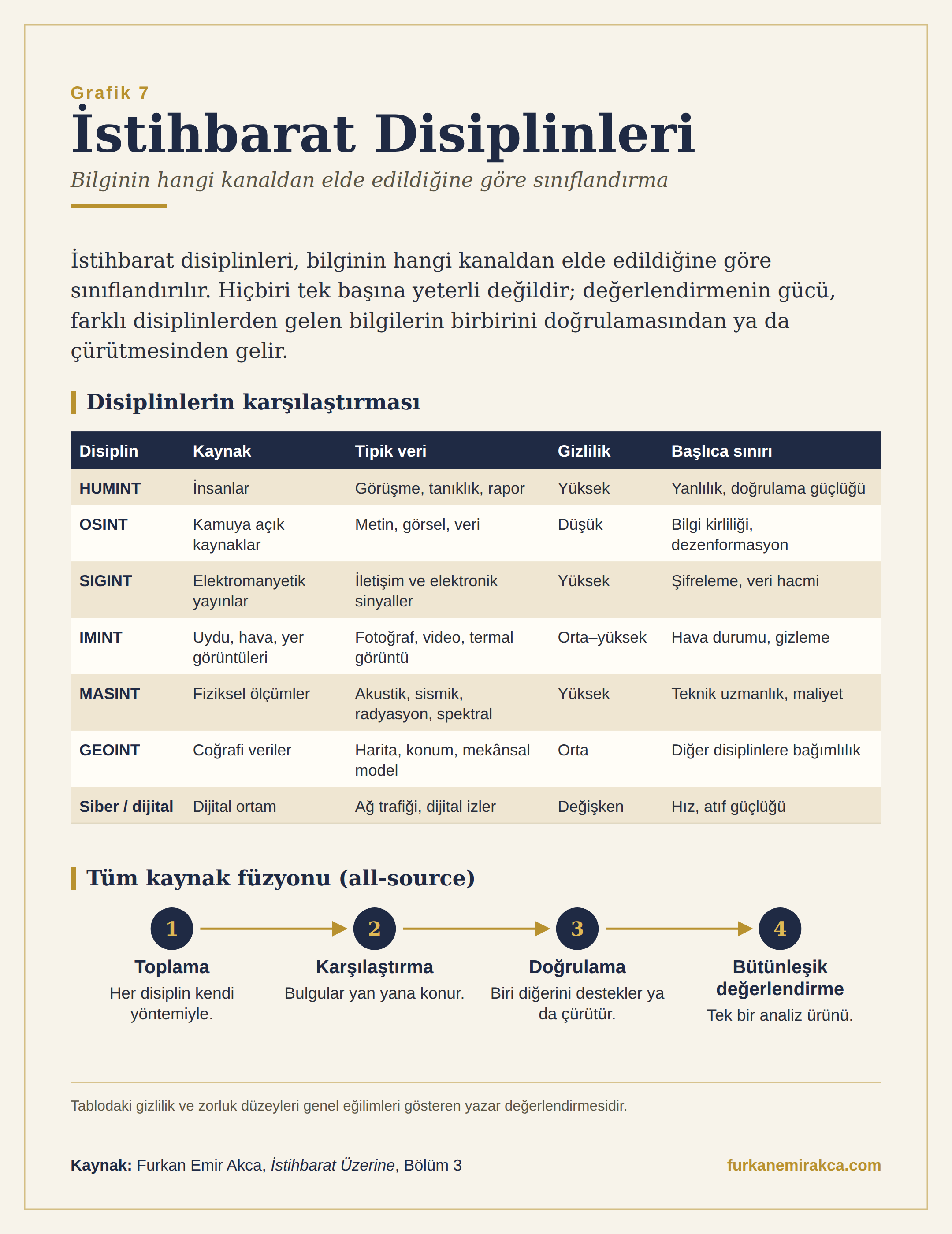
Each discipline has a different strength. HUMINT stands out in understanding intent and context, SIGINT in monitoring communications, IMINT in seeing physical activity, MASINT in measuring technical signatures, and OSINT in broad and fast access. Their limits are also different: bias, encryption, weather conditions, cost or information pollution.
This is why in modern intelligence literature no discipline is considered sufficient on its own. In the approach called “all-source fusion”, information from different disciplines is placed side by side so that it confirms or refutes each other.
The secrecy and difficulty levels in the comparison table in the graphic are an assessment showing the general tendencies of the disciplines; in a concrete piece of work these levels may vary according to the subject and source.
More in the book
✓ İSTİHBARAT ÜZERİNE
This subject is dealt with in detail in my book İstihbarat Üzerine under the heading Chapter 3 — Intelligence Sources and Disciplines. The whole book can be read free of charge.
Note on method. Unless a final court judgment exists regarding persons named in these files, incriminating information is presented only together with its source and as an allegation. Detention, arrest or giving testimony does not imply guilt. The evidence labels indicate what a statement rests on, not a verdict on whether it is true.
This is an English translation. The Turkish original is the authoritative text: Türkçe asıl metin